

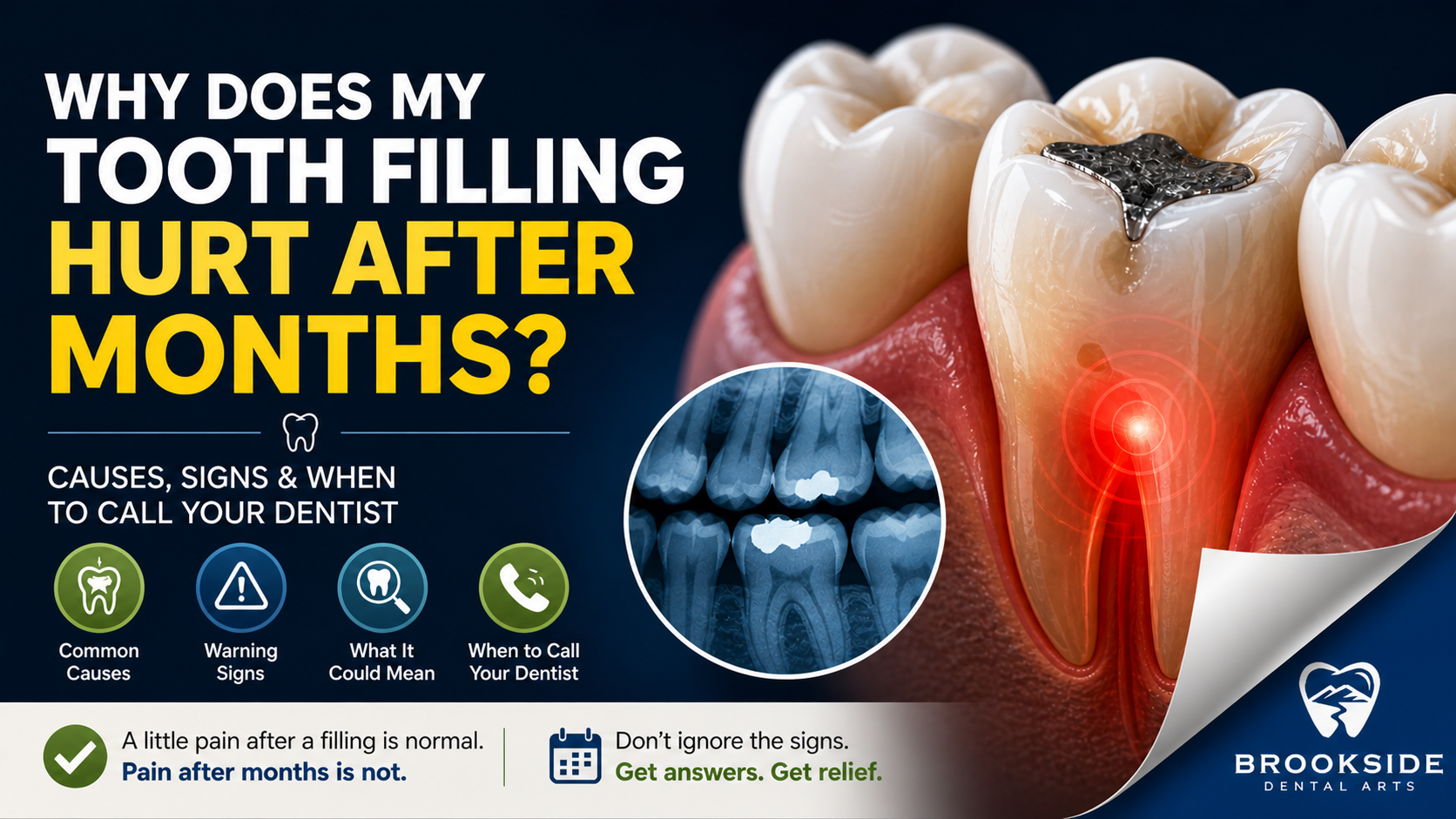
15 May Why Does My Tooth Filling Hurt After Months? Causes, Signs & When to Call Your Dentist
🟢 Quick Answer
Pain months after a tooth filling is not normal and may indicate bite misalignment, nerve irritation, decay beneath the filling, or infection. While mild sensitivity for a few days after a filling is common, pain that returns or worsens months later should be evaluated by a dentist promptly.
If you are wondering why my tooth filling hurts after months, the cause may range from a simple bite adjustment to a more serious issue such as a cracked filling, pulp inflammation, or an active dental infection.
If you’re wondering “why does my tooth filling hurt after months,” you’re not alone — and your concern is completely valid. A dental filling is designed to stop pain, not prolong it. Yet delayed or recurring discomfort after a filling is one of the most common concerns patients bring to Brookside Dental Arts.
Some mild sensitivity in the days immediately after a filling is a normal part of healing. However, pain that reappears or persists weeks or months later is a clear signal that something beneath the surface needs attention. Ignoring it rarely makes it better — and in some cases, it allows the underlying problem to progress into something far more serious.
In this guide, Dr. Angra walks you through every major cause of delayed filling pain, the warning signs you should never ignore, a clear comparison to help you identify whether you may be dealing with an infection, and exactly when it’s time to call your dentist.
Is It Normal for a Tooth Filling to Hurt After Months?
Mild sensitivity for a few days after a filling is expected and normal. During the procedure, your tooth goes through significant work — decay is drilled out, the inner layers of the tooth are exposed, and a new material is bonded in place. The nerve endings inside the tooth naturally respond to this with heightened sensitivity to temperature, pressure, and sweets for a short period.
For most patients, this fades within one to two weeks as the tooth settles around the new restoration. However, pain that lingers beyond two weeks, fades and then returns months later, or intensifies over time is not a normal part of healing. It indicates that something has changed within the tooth, the filling, or the surrounding tissue that warrants professional evaluation.
| 💡 Rule of thumb: Normal post-filling sensitivity improves day by day. If your tooth is getting worse or has started hurting again months later, that is not a healing tooth — that is a tooth asking for help. |
7 Common Causes of Tooth Filling Pain After Months
There are several distinct reasons why a filled tooth can become painful long after the original procedure. Here are the most common causes Dr. Angra diagnoses at Brookside Dental Arts.
1. Bite Misalignment (High Filling)
One of the most frequent culprits is a filling that sits slightly too high relative to your surrounding teeth. Every time you close your mouth or chew, that single tooth absorbs disproportionate pressure — pressure the tooth was not designed to handle alone. Over weeks and months, this repeated stress causes progressive soreness, sensitivity, and sharp pain when biting down.
A high filling is easily missed at the time of placement because the anesthesia numbs the area and makes it difficult to accurately gauge your natural bite. The problem only surfaces once you resume normal eating habits. The good news: this is one of the quickest fixes in dentistry. Your dentist can smooth the filling down in just a few minutes, and relief is usually immediate.
2. Nerve Irritation or Pulpitis
When a cavity is deep, the drilling process can come very close to — or disturb — the dental pulp, the innermost layer of the tooth that contains your nerves and blood vessels. This trauma can cause the pulp to become inflamed, a condition known as pulpitis.
Reversible pulpitis means the nerve is irritated but capable of healing with time. Irreversible pulpitis means the nerve has been damaged beyond recovery. Pain that is persistent, throbbing, and worse at night is a hallmark of irreversible pulpitis — and in those cases, a root canal treatment is typically the most effective way to relieve the pain and save the tooth.
3. Cracked or Fractured Filling
Fillings endure years of chewing force, temperature fluctuations, and mechanical stress. Over time, this can cause a filling to crack or fracture — exposing the sensitive inner layers of the tooth to bacteria, food particles, and temperature changes. Even hairline fractures that are invisible to the naked eye can cause significant and worsening discomfort.
If left untreated, a cracked filling creates an entry point for bacteria, which can lead to secondary decay or infection beneath the restoration. Your dentist may use a special dye, explorer probe, or X-rays to identify fractures that are not visible on the surface.
4. Secondary Decay Beneath the Filling
A filling seals out bacteria when it is first placed — but it does not make the tooth permanently immune to decay. If oral hygiene is not maintained, or the seal between the filling and tooth begins to break down over time, bacteria can infiltrate the margins of the restoration and cause new decay to form underneath.
This secondary decay often goes unnoticed until it reaches a deeper layer of the tooth and triggers pain or sensitivity. Because it develops beneath the existing filling, it cannot be seen without dental X-rays — another strong reason why regular checkups at Brookside Dental Arts are so important.
5. Leaking or Failed Filling.
Over time, the bond between a filling and the natural tooth structure can weaken. When the seal fails, a microscopic gap — called microleakage — forms between the tooth and the filling. Bacteria and saliva seep into this gap, causing decay, infection, and persistent sensitivity.
Patients with a leaking filling often notice a lingering bad taste, mild sensitivity to cold or sweet foods, or a vague feeling that the tooth is “off” when biting. A failed filling typically needs to be replaced. Our team offers a full range of dental filling options to restore your tooth comfortably and durably.
6. Bruxism (Teeth Grinding)
Bruxism — habitual grinding or clenching of the teeth, most often during sleep — places extreme and repeated pressure on dental restorations. Over months, this force can wear down or fracture a filling, cause bite misalignment, and trigger ongoing sensitivity in the tooth underneath.
Many patients are unaware they grind their teeth because it happens unconsciously at night. Common signs include waking with a sore jaw, morning headaches, or teeth that feel worn or flattened. A custom night guard can protect both your natural teeth and your restorations from the damaging effects of bruxism.
7. Infection or Dental Abscess
In more serious cases, filling pain that develops or worsens over months may indicate that bacteria have reached the dental pulp and caused an infection. A dental abscess — a pocket of pus that forms at the root of the tooth — is a sign that the infection has advanced significantly.
Infection-related pain is typically more severe and consistent than other types of filling discomfort. It may include throbbing or pulsating pain, swelling in the gum or jaw, a bad taste or persistent bad breath, and sensitivity to even light pressure on the tooth. This is a dental emergency that requires prompt treatment to prevent the infection from spreading.
Warning Signs You Should Never Ignore
Some mild post-filling sensitivity can be managed at home for a short period. The following symptoms, however, are clear red flags. Do not wait these out — contact your dentist promptly if you experience any of the following.
- Throbbing or pulsating pain that does not respond to over-the-counter pain relief
- Pain that wakes you up at night or feels worse when you lie down
- Visible swelling in the gum, cheek, or jaw near the filled tooth
- A pimple-like bump on the gum near the tooth, which may indicate a draining abscess
- Fever alongside tooth pain — even a low-grade one
- A persistent foul taste in the mouth that does not resolve with brushing
- Sharp pain when biting that has been present for more than two weeks
- Sensitivity to hot or cold that lingers for more than 30 seconds after the stimulus is removed
- A feeling that your bite is uneven or that the tooth has shifted
| ⚠️ Do not wait: Swelling, fever, or difficulty swallowing alongside tooth pain requires urgent dental care. Dental infections can spread to the jaw, neck, and beyond. Do not delay. |
📞 Is your filling pain worsening or not going away? Don’t wait for it to become an emergency. Contact our dental team at Brookside Dental Arts for a quick evaluation — early treatment is always easier, faster, and more affordable.
Contact Us
Filling Pain vs. Tooth Infection: How to Tell the Difference
One of the most common questions patients ask is whether their discomfort is simply post-filling sensitivity or something more serious like an active infection. The table below highlights the key differences to help you identify what you may be experiencing — though a proper diagnosis always requires a professional evaluation.
| Factor | Filling Pain | Tooth Infection |
|---|---|---|
| Pain type | Mild to moderate sensitivity | Severe, throbbing, persistent |
| Duration | May come and go | Constant and worsening over time |
| Temperature | Brief sensitivity to hot/cold | Lingering pain after stimulus |
| Swelling | Rarely present | Common — gum, jaw, or cheek |
| Fever | Not typically present | Possible with spreading infection |
| Bad taste/odor | Uncommon | Often present (draining abscess) |
| Night pain | Mild or absent | Often worsens when lying down |
| Urgency | See dentist soon | Seek care immediately |
If several symptoms in the “Tooth Infection” column match what you are experiencing, please seek dental care promptly. An untreated infection does not resolve on its own and can escalate into a serious health risk.
What to Expect at Your Appointment?
When you visit Brookside Dental Arts for post-filling pain, Dr. Angra will take a structured approach to identifying the root cause of your discomfort. The evaluation typically involves the following steps.
- A thorough conversation about your symptoms — when the pain started, what triggers it, how long it lasts, and whether it is getting worse
- A clinical exam of the affected tooth and surrounding tissue, including a bite check and visual assessment of the filling’s condition.
- Dental X-rays to check for decay beneath the filling, infection at the root tip, or changes in the surrounding bone.
- Sensitivity testing to assess how the nerve inside the tooth is responding to temperature and pressure..
Based on these findings, Dr. Angra will recommend the most conservative and effective treatment to resolve your pain and protect the long-term health of your tooth.
Treatment Options for Post-Filling Pain
The right treatment depends entirely on the cause. Here is an overview of the most common solutions used at Brookside Dental Arts.
✔️ Bite Adjustment
If the filling is sitting too high, Dr. Angra will gently reshape it to bring your bite back into proper alignment. This is painless, takes just a few minutes, and typically provides immediate relief.
✔️ Filling Replacement
If the filling has cracked, the seal has broken down, or secondary decay has formed underneath, the old restoration will be carefully removed and replaced. Depending on the extent of damage, options include a new composite filling, inlay, or ceramic crown.
✔️ Root Canal Therapy
Root canal therapy is the most effective way to relieve pain and save the tooth. The infected pulp is removed, the canals are cleaned and sealed, and the tooth is restored with a crown. Root canals are far more comfortable than their reputation suggests — most patients are relieved by how straightforward the experience is.
✔️ Night Guard for Bruxism
If teeth grinding is identified as a contributing factor, a custom night guard protects your restorations and natural teeth from the ongoing effects of bruxism. It is one of the most cost-effective investments you can make in the longevity of your dental work.
✔️ Antibiotic Therapy
In cases where a dental infection is present, antibiotics may be prescribed alongside dental treatment to help control bacterial spread. It is important to understand that antibiotics alone will not resolve a dental infection — the source of the infection must be addressed through appropriate dental treatment.
How to Prevent Filling Pain in the Future
While not every complication can be anticipated, the following habits go a long way in protecting your restorations and avoiding the frustration of recurring filling problems.
✅ Brush twice daily with fluoride toothpaste and floss daily to prevent new decay from forming around or beneath existing fillings.
✅ Attend regular checkups at Brookside Dental Arts every six months so Dr. Angra can monitor your fillings for early signs of wear, cracking, or seal failure before they become painful.
✅ Report any changes in your bite immediately after a new filling — adjustments are easy when caught early.
✅ Wear a custom night guard if you grind or clench your teeth to reduce stress on your restorations.
✅ Avoid chewing on ice, hard candies, pens, or other hard objects that can crack or fracture dental work.
✅ Limit acidic and sugary foods and beverages, which erode enamel and increase the risk of decay forming at filling margins.
How Long Should a Filling Last?
With proper care, modern dental fillings are built to last. Composite resin fillings typically last between 7 and 10 years, while porcelain and gold restorations can last 15 years or longer. The lifespan of any filling depends on its size and location, the material used, your oral hygiene habits, and whether you grind your teeth.
However, the lifespan of a filling depends on several factors including the size and location of the restoration, the materials used, your oral hygiene habits, and whether you grind your teeth. Regular dental visits allow Dr. Angra to assess the integrity of your fillings and recommend timely replacement before small issues become bigger, more costly problems.
FAQ
Why does my filling hurt when I bite down?
Pain when biting down after a filling may indicate a high filling, cracked tooth, nerve irritation, or inflammation inside the tooth. A dentist can evaluate the cause and adjust or replace the filling if necessary.
Can a cavity come back under a filling?
Yes. New decay can develop beneath or around a filling if bacteria enter through cracks, gaps, or worn edges in the restoration. This is known as secondary decay and may require the filling to be replaced.
When should I see a dentist for pain?
You should contact your dentist if filling pain lasts more than two weeks, worsens over time, causes swelling, or becomes sensitive to pressure, heat, or cold. Persistent pain may indicate nerve irritation or infection.
Final Thoughts
If you have been asking yourself “why does my tooth filling hurt after months, please do not dismiss it or simply hope it goes away. Whether the cause turns out to be something straightforward like a minor bite adjustment or something more serious like a failing restoration or active infection — early evaluation and treatment always leads to a better, faster, and more affordable outcome than waiting.
If you’re in Pennington, NJ, or the surrounding areas, the team at Brookside Dental Arts is here to help. Dr. Angra provides thorough, compassionate evaluations to get to the root of your discomfort and restore your comfort with the most conservative treatment possible. Your smile deserves attentive, personalized care — and so do you.
| 📍 Schedule your visit: Contact Brookside Dental Arts at brooksidedentalarts.com/contact to book a consultation with Dr. Angra. Early evaluation means better outcomes — and a pain-free smile sooner. |
About Dr. Angra

Dr. Angra earned her DMD from Tufts University School of Dental Medicine and has practiced dentistry across Massachusetts, New York, New Jersey, and India. She is committed to providing patient-focused, compassionate dental care with an emphasis on long-term oral health and education.
Sorry, the comment form is closed at this time.