

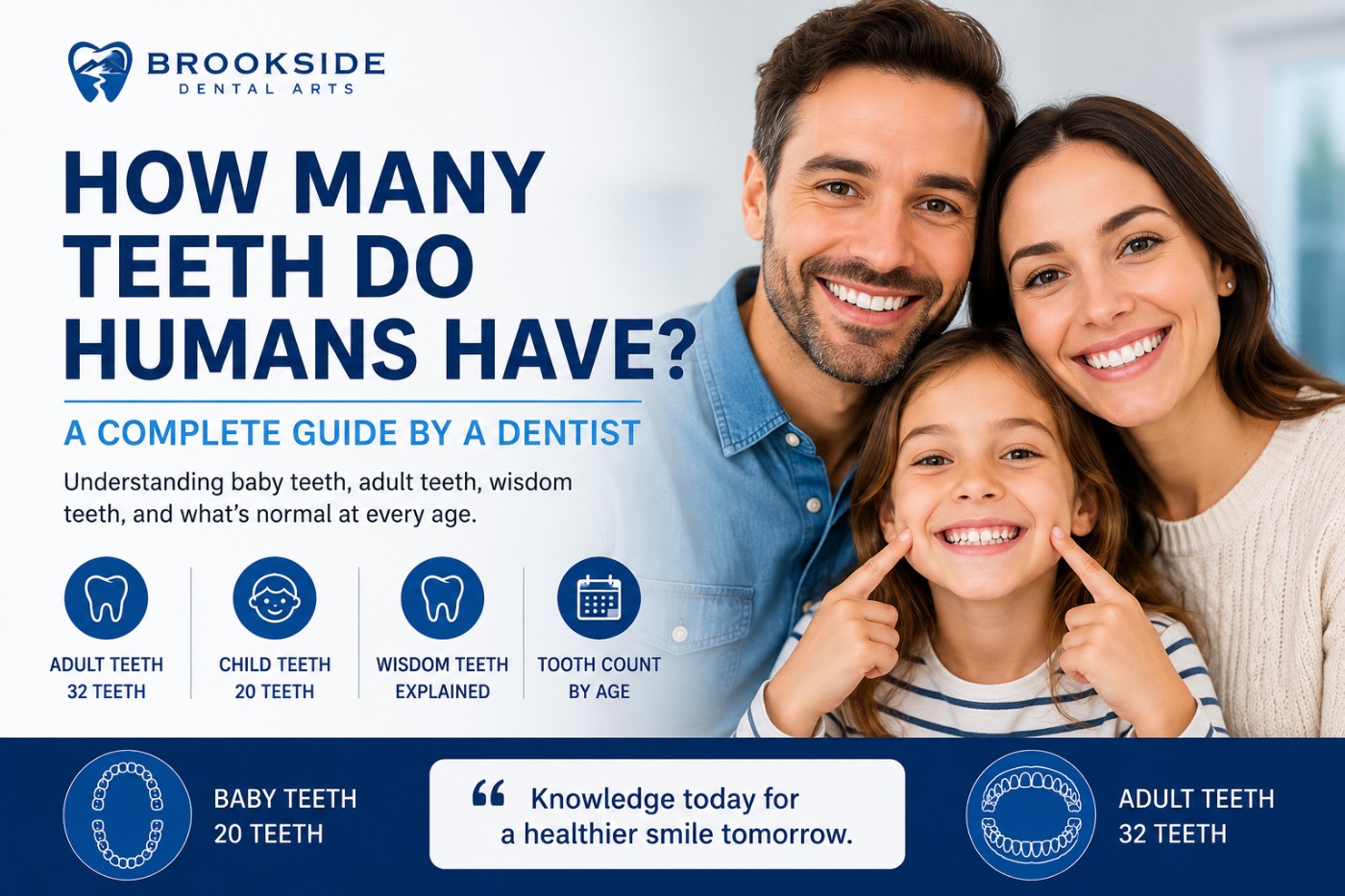
07 Jul How Many Teeth Do Humans Have? A Complete Guide by a Dentist
👩⚕️ Written & Reviewed by Dr. Angra, DMD
Dr. Angra is a DMD graduate of Tufts University School of Dental Medicine and a practicing dentist serving patients in Pennington, NJ and surrounding areas. This article is written from clinical experience and is intended for educational purposes only.
🟢 Quick Answer
To relieve tooth pain after a filling, rinse with warm salt water, take over-the-counter anti-inflammatory medication, avoid chewing on the treated side, and apply a clove oil compress for temporary numbing. If pain persists beyond two weeks or worsens, contact your dentist — it may indicate a bite issue, nerve irritation, or a filling that needs adjustment.
How many teeth do humans have? It is one of the most common questions Dr. Angra hears at Brookside Dental Arts — and the honest answer depends entirely on age. Children have a different number of teeth than adults, and adults themselves can have anywhere from 28 to 32 teeth depending on whether their wisdom teeth have erupted, been removed, or never developed at all.
Understanding the normal tooth count at each stage of life helps you recognize what is typical, what to expect as your child grows, and when a missing or extra tooth might need professional evaluation. In this guide, Dr. Angra breaks down the complete picture — from baby teeth through the full adult set — along with the function of each tooth type and what to do if your count looks different than expected.
How Many Teeth Do Adults Have?
The typical adult human mouth contains 32 teeth once all teeth, including the four wisdom teeth, have fully erupted. This full set is divided evenly between the upper and lower jaw, with 16 teeth on top and 16 on the bottom.
These 32 teeth are made up of four distinct types, each suited to a different function in chewing and biting: 8 incisors at the front for cutting, 4 canines for tearing, 8 premolars for crushing, and 12 molars (including the 4 wisdom teeth) for grinding food into a digestible form.
| Tooth Type | Count (Adult Mouth) | Primary Function |
| Incisors | 8 (4 upper, 4 lower) | Cutting and biting food |
| Canines | 4 (2 upper, 2 lower) | Tearing food |
| Premolars | 8 (4 upper, 4 lower) | Crushing and tearing |
| Molars | 8 (4 upper, 4 lower) | Grinding and chewing |
| Wisdom Teeth (3rd Molars) | 4 (2 upper, 2 lower) | Grinding — vestigial in modern humans |
How Many Teeth Do Children Have?
Children have a total of 20 baby teeth, formally known as primary or deciduous teeth. These begin erupting around 6 months of age and are typically all present by around age 3. The 20 baby teeth consist of 8 incisors, 4 canines, and 8 molars — notably, children do not have premolars in their primary set.
Baby teeth serve essential functions beyond just chewing: they help children learn to speak clearly, maintain space in the jaw for permanent teeth, and support healthy facial development. Around age 6, baby teeth begin to loosen and fall out as permanent teeth push through underneath, a process that continues gradually until approximately age 12 or 13.
Tooth Count by Age: The Complete Timeline
Use this table as a quick reference for how many teeth are typical at each stage of life, from infancy through full adulthood.
| Stage | Total Teeth | Age Range | Notes |
| Baby Teeth (Primary) | 20 teeth | 6 months – 3 years | 10 upper, 10 lower |
| Mixed Dentition | 20–28 teeth | 6–12 years | Baby teeth fall out as adult teeth erupt |
| Adult Teeth (without wisdom) | 28 teeth | 12–17 years | Fully erupted permanent set |
| Adult Teeth (with wisdom) | 32 teeth | 17–25 years | Includes all 4 third molars |
| Adults missing wisdom teeth | 28–31 teeth | Any adult age | Common — genetic variation |
Why Do Some Adults Have Fewer Than 32 Teeth?
It is extremely common for adults to have fewer than the full 32 teeth, and in most cases this is not a cause for concern. The most frequent reasons include:
- Congenitally missing wisdom teeth — between 5% and 37% of people never develop one or more wisdom teeth at all, a normal genetic variation
- Wisdom tooth extraction — many people have their wisdom teeth removed due to impaction, crowding, or infection risk
- Tooth extraction from decay or trauma — a tooth lost to severe decay, infection, or injury that was not replaced
- Orthodontic extraction — some orthodontic treatment plans involve removing teeth (often premolars) to create space for proper alignment
- Hypodontia — a condition where one or more teeth, beyond just wisdom teeth, never develop
| ⚠️ When to see a dentist: If you are missing teeth and are unsure why, or if you notice a gap that wasn’t there before, a dental X-ray can clarify whether a tooth is congenitally absent, impacted, or was lost without your awareness. This is also worth discussing if you are missing more than 2–3 adult teeth, as it may affect your bite and long-term oral health. |
| 📞 Curious about your own tooth count, or noticing a gap you can’t explain? Schedule a checkup at Brookside Dental Arts. Dr. Angra can take X-rays to confirm exactly how many teeth you have and identify any that may still be developing. Book at brooksidedentalarts.com/contact |
Can You Have More Than 32 Teeth?
Yes — though it is uncommon. A condition called hyperdontia causes extra teeth, known as supernumerary teeth, to develop beyond the normal 32. These extra teeth most commonly appear near the upper front incisors or behind the wisdom teeth, and can sometimes cause crowding, misalignment, or delayed eruption of nearby teeth.
Hyperdontia is typically identified through a routine dental X-ray and may or may not require treatment depending on whether the extra tooth is causing functional or cosmetic problems. If you suspect you may have an extra tooth, a panoramic X-ray at your next checkup will confirm it.
Frequently Asked Questions
Humans have 32 teeth in total when all four wisdom teeth have erupted. This includes 8 incisors, 4 canines, 8 premolars, and 12 molars, evenly split between the upper and lower jaw.
A 5-year-old should have their full set of 20 baby teeth, as the primary set is typically complete by around age 3 and remains until permanent teeth begin replacing them around age 6.
Yes, having 28 teeth as an adult is very common and normal, particularly if your wisdom teeth were removed or never developed. Many adults function perfectly well with 28 teeth.
Losing even one adult tooth without replacement can eventually affect your bite and shift surrounding teeth over time. If you are missing more than 2 to 3 teeth, it is worth discussing replacement options like an implant or bridge with your dentist.
Final Thoughts
So, how many teeth do humans have? The full adult answer is 32, the full childhood answer is 20, and the real-world answer for most adults falls somewhere between 28 and 32 depending on wisdom teeth and individual dental history. All of these variations are within the range of normal, and what matters most is the health and function of the teeth you do have.
At Brookside Dental Arts, Dr. Angra provides thorough dental exams for patients of all ages to track tooth development, monitor wisdom teeth, and address any concerns about missing or extra teeth. If you are in Pennington, NJ or the surrounding area and have questions about your own tooth count or your child’s dental development, we are here to help.
📍 Schedule your checkup: Contact Brookside Dental Arts at brooksidedentalarts.com/contact to book with Dr. Angra for a complete dental evaluation.
About Dr. Angra

Dr. Angra earned her DMD from Tufts University School of Dental Medicine and has practiced dentistry across Massachusetts, New York, New Jersey, and India. A proud member of the ADA and NJDA, she is known for her compassionate approach and commitment to high-quality, patient-centered care. Outside the office, she enjoys hiking with her family and exploring New Jersey’s diverse food scene.
Sorry, the comment form is closed at this time.