

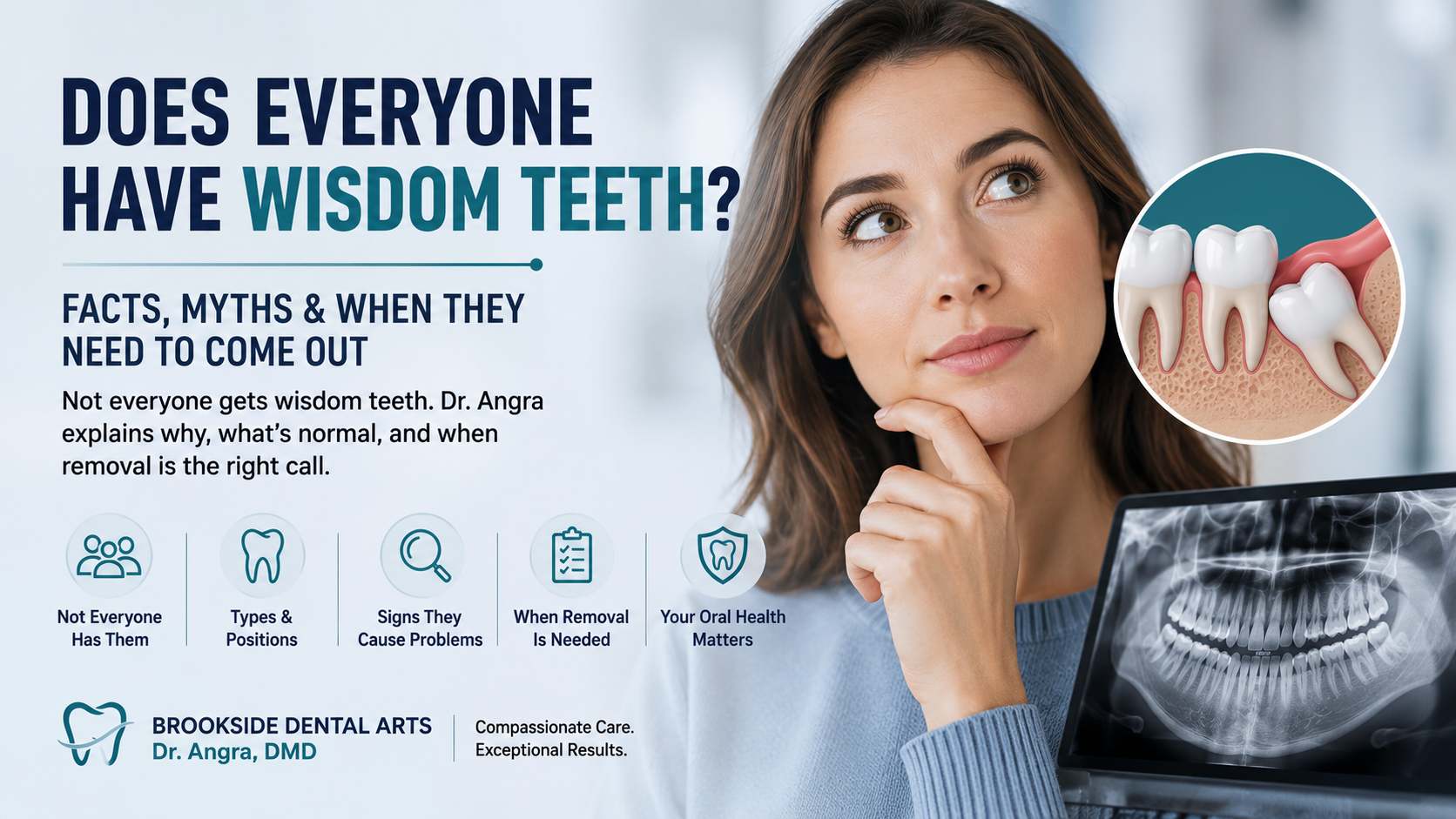
15 Jun Does Everyone Have Wisdom Teeth? Facts, Myths & When They Need to Come Out
By Dr. Angra, DMD — Brookside Dental Arts
👩⚕️ Written & Reviewed by Dr. Angra, DMD
Dr. Angra is a DMD graduate of Tufts University School of Dental Medicine and a practicing dentist serving patients in Pennington, NJ and surrounding areas. This article draws on clinical experience and current dental research. It is intended for educational purposes and does not replace a personalized dental consultation.
🟢 Quick Answer
No, not everyone has wisdom teeth. Studies suggest that between 5% and 37% of people are missing one or more wisdom teeth entirely due to genetic variation. Some people develop all four, some develop fewer, and some develop none at all. Whether or not wisdom teeth cause problems depends on how they grow, how much space is available in the jaw, and how well they can be kept clean.
Does everyone have wisdom teeth? It is one of the most common questions patients ask at Brookside Dental Arts — and the answer surprises many people. Wisdom teeth, formally known as third molars, are often portrayed as a universal rite of passage: something everyone gets, usually in their late teens, and often has it removed. But the reality is significantly more nuanced than that.
The truth is that wisdom teeth are one of the most variable features in the human mouth. Some people develop all four. Some develop only one or two. Some develop none at all. And for those who do have them, the experience ranges from completely symptom-free to acutely painful and requiring urgent removal.
In this guide, Dr. Angra walks you through everything you need to know about wisdom teeth — the science behind why some people have them and others don’t, the most common myths debunked, the six types of wisdom tooth presentations, and a clear framework for understanding when removal is recommended and when it is not.
What Are Wisdom Teeth and Why Do We Have Them?
Wisdom teeth are the third and final set of molars to develop in the human mouth. Most people who develop them will see them begin to emerge between the ages of 17 and 25, which is why they are colloquially known as wisdom teeth — they arrive at an age associated with the onset of maturity.
From an evolutionary standpoint, wisdom teeth made considerable sense for our ancestors. Early humans consumed a diet of raw meat, roots, nuts, and coarse plant material that caused significant tooth wear over time. By the time a person reached their late teens or early twenties, several of their back molars had often been damaged or lost. The third molars provided a useful replacement set that allowed continued chewing function.
The human jaw has also changed dramatically over thousands of years of evolution. As diets shifted toward softer, cooked, and processed foods, the jaw gradually became smaller — but the genetic instructions for producing wisdom teeth did not disappear at the same rate. The result is a common modern mismatch: teeth that our ancestors needed but that many of us no longer have room for.
🟢 Dr. Angra explains
Wisdom teeth are essentially evolutionary remnants. They served an important purpose for early humans, but the modern jaw often simply does not have enough space to accommodate them comfortably. This is why impaction and removal are so common today.
Does Everyone Have Wisdom Teeth? The Science Explained
The straightforward answer is “NO” — not everyone has wisdom teeth, and this is entirely normal. The presence, number, and position of wisdom teeth are all determined by genetics, and there is considerable natural variation across individuals and populations.
Research published in dental and anthropological literature consistently shows that congenital absence of one or more wisdom teeth — a condition called hypodontia of the third molar — is one of the most common dental variations in the human population. Studies estimate that between 5% and 37% of people are missing at least one wisdom tooth, with significant variation across different ethnic groups and geographic populations.
Some of the key findings from research on wisdom tooth prevalence include:
- Approximately 20 to 25 percent of the general population is missing at least one wisdom tooth
- Around 5 to 10 percent of people never develop any wisdom teeth at all
- Some people develop one, two, or three wisdom teeth rather than the full complement of four
- In certain Southeast Asian and Indigenous populations, the rate of congenital absence is significantly higher
- The pattern of absence is often hereditary — if one of your parents was missing wisdom teeth, you are more likely to be as well
The variation in wisdom tooth development is thought to reflect ongoing human evolution. Some anthropologists believe that humans are gradually evolving away from third molars entirely, and that future generations may commonly lack them altogether.
⚠️ Common misconception:
Many people assume that if they have not felt their wisdom teeth, they do not have any. This is not always true. Wisdom teeth can be fully impacted within the jawbone and never erupt — yet still be present and potentially cause problems. Only a dental X-ray can confirm whether wisdom teeth are present, absent, or impacted.
5 Common Wisdom Teeth Myths
There is no shortage of misinformation about wisdom teeth. Here are the five most common myths Dr. Angra hears from patients at Brookside Dental Arts, along with the clinical facts.
MYTH: Everyone gets wisdom teeth.
✅ FACT: Between 5% and 37% of people are congenitally missing one or more wisdom teeth. Not having them is a normal genetic variation, not a deficiency.
MYTH: If wisdom teeth don’t hurt, they don’t need to be removed.
✅ FACT: Many impacted or problematic wisdom teeth cause no pain at all — yet can still be damaging adjacent teeth, forming cysts, or trapping bacteria. Absence of pain does not mean absence of a problem.
MYTH: Wisdom teeth always need to come out.
✅ FACT: Not true. Wisdom teeth that are fully erupted, properly positioned, and easy to clean can remain in the mouth indefinitely without causing problems. Removal is only recommended when there is a clinical reason.
MYTH: Wisdom teeth cause crowding of the front teeth.
✅ FACT: This is a widely repeated claim but lacks strong scientific support. Modern dental research suggests that wisdom teeth alone do not generate enough force to shift front teeth. Crowding has more to do with jaw size, bite, and natural aging.
MYTH: It is always better to remove wisdom teeth early, even if they are fine.
✅ FACT: Prophylactic (preventive) removal of asymptomatic, fully impacted wisdom teeth is no longer universally recommended. Guidelines from major dental associations now advocate a monitoring approach unless there is a specific clinical indication for removal.
6 Types of Wisdom Tooth Presentations
Not all wisdom teeth are alike. How they develop, grow, and position themselves in the jaw varies considerably from person to person. Here is a breakdown of the six main presentations your dentist may identify on X-ray or clinical examination.
| Type | What It Means | Common Symptoms |
|---|---|---|
| Fully Erupted | Tooth has fully broken through the gum line and is visible | Usually none if healthy and hygienic |
| Partially Erupted | Crown partially visible; gum flap still covers part of the tooth | Pain, swelling, bad taste, pericoronitis |
| Soft Tissue Impacted | Crown through bone but blocked by gum tissue | Gum swelling, difficulty cleaning, infection risk |
| Partial Bony Impacted | Partially through jawbone but not fully erupted | Jaw pain, pressure, swelling, headache |
| Full Bony Impacted | Completely enclosed within the jawbone | Often silent; discovered on X-ray; cyst risk |
| Congenitally Missing | Never developed — absent from birth | No symptoms; confirmed by dental X-ray |
Understanding which type of wisdom tooth presentation you have is essential for making an informed decision about whether monitoring or removal is the right approach for you.
When Do Wisdom Teeth Come In?
For most people who develop wisdom teeth, they begin to emerge between the ages of 17 and 25. However, the timing can vary significantly. Some patients see their wisdom teeth begin to push through the gum as early as 16, while others do not experience any eruption until their late twenties or even early thirties.
The eruption process can take months or even years to complete, particularly when there is insufficient space in the jaw or the tooth is angled in a way that slows its progress. In some cases, a wisdom tooth may begin to emerge and then appear to stop — a situation that should be monitored by your dentist.
What Age Do Wisdom Teeth Come In? A Complete Guide for Teens & Adults
Signs That Your Wisdom Teeth Are Coming In
Wisdom teeth do not always announce themselves loudly. Some patients experience very little discomfort during eruption, while others have significant symptoms that affect daily life. Common signs that wisdom teeth are beginning to emerge include:
- A dull, persistent ache at the back of the jaw on one or both sides
- Tenderness or soreness in the gum tissue at the very back of the mouth
- Swollen or puffy gum tissue behind the last visible molar
- Difficulty or discomfort when opening the mouth wide
- A faint pressure sensation that comes and goes in the jaw
- Occasional headaches or earaches on the affected side
- A visible white edge or cusp beginning to break through the gum
First Signs of Wisdom Teeth Coming In: What You Need to Know
📞 Not sure whether your wisdom teeth are coming in or causing a problem? Schedule a wisdom tooth evaluation at Brookside Dental Arts. Dr. Angra will take X-rays, assess your specific situation, and give you a clear, honest recommendation. Book at www.brooksidedentalarts.com/contact
When Do Wisdom Teeth Need to Come Out?
This is the question most patients ultimately want answered — and the honest answer is: it depends on your specific clinical situation. There is no blanket rule that applies to every wisdom tooth in every patient. Here is the framework Dr. Angra uses when evaluating whether removal is indicated.
Clear Indications for Removal
The following situations generally indicate that wisdom tooth removal is the appropriate course of action:
- Recurrent pericoronitis — repeated infection of the gum tissue around a partially erupted wisdom tooth
- Active decay in the wisdom tooth that cannot be adequately restored due to its position
- Damage to the adjacent second molar caused by the wisdom tooth pressing against it
- Development of a dental cyst or tumor around an impacted wisdom tooth
- Abscess or spreading infection associated with the wisdom tooth
- Significant crowding or bite problems attributed to the position of the wisdom tooth
- Orthodontic treatment plan that requires space creation in the jaw
Situations Where Monitoring Is Appropriate
Not every wisdom tooth needs to be removed immediately — or ever. Monitoring is an appropriate approach when:
- The wisdom tooth is fully erupted, well-aligned, and easy to clean with a standard toothbrush
- The tooth is fully impacted in bone, asymptomatic, and not pressing against adjacent teeth
- The patient is older and the surgical risk of removal outweighs the clinical benefit
- There is no evidence of decay, infection, cyst formation, or adjacent tooth damage
Regular dental X-rays — typically every one to two years for patients with retained wisdom teeth — allow Dr. Angra to monitor for any changes and intervene before problems develop.
Wisdom Tooth Removal: Should Yours Come Out?
Use this reference table to understand how different wisdom tooth situations are typically approached at Brookside Dental Arts.
| Situation | Removal Recommended? | Why |
|---|---|---|
| Fully erupted, healthy, easy to clean | No — monitor regularly | No clinical indication for removal |
| Partially erupted (pericoronitis risk) | Yes — often recommended | Bacteria trap under gum flap causes repeated infection |
| Impacted (bone or soft tissue) | Yes — usually recommended | Pressure on adjacent teeth, cyst formation risk |
| Causing pain or recurring infection | Yes — promptly | Active problem that will not resolve without removal |
| Crowding adjacent teeth | Yes — often recommended | Protects alignment and bite integrity |
| Cavity in wisdom tooth hard to treat | Yes — extraction often preferred | Deep location makes fillings short-lived |
| No symptoms, fully impacted in bone | Discuss with dentist | Risk vs. benefit varies by age and anatomy |
Every patient’s situation is unique. The table above provides general guidance, but a full clinical examination and X-ray evaluation by Dr. Angra is the only way to determine the right approach for your specific wisdom teeth.
What to Expect If Your Wisdom Teeth Need to Come Out
If removal is recommended, understanding the process can help reduce anxiety and prepare you for a smooth experience.
✅The Procedure
Wisdom tooth removal is one of the most commonly performed dental procedures and is well within the scope of an experienced general dentist. Under local anesthesia — and sedation options if preferred — the gum tissue is gently reflected, the tooth is loosened and removed, and the site is closed with dissolvable sutures if needed. Fully erupted wisdom teeth are typically straightforward to remove. Impacted teeth may require a small amount of bone removal to access them.
Emergency Wisdom Tooth Removal: When It’s Needed, Procedure, and Recovery
✅Recovery:
Most patients recover comfortably within three to five days following wisdom tooth removal. Swelling, mild discomfort, and some restriction on eating are to be expected in the first 48 hours. Following your aftercare instructions carefully makes a significant difference in recovery speed and comfort.
Wisdom Teeth Removal Recovery: What to Expect & How Long It Really Takes
✅What to Eat
Diet plays an important role in wisdom tooth recovery, and what you eat in the first few days can directly affect how quickly and smoothly you heal. The general rule is to stick to soft, cool, and easy-to-chew foods that do not require force or suction.
Good options in the first 48 hours include yogurt, mashed potatoes, scrambled eggs, smoothies (without a straw), soup broth, applesauce, and soft-cooked oatmeal. These foods provide nutrition without placing stress on the extraction site or dislodging the protective blood clot.
Foods to avoid during recovery include anything hard, crunchy, or chewy such as chips, nuts, raw vegetables, tough meat, and crusty bread. Extremely hot foods and beverages should also be avoided as they can dissolve the clot and delay healing. Alcohol and carbonated drinks are best avoided for at least 48 to 72 hours.
As comfort improves — usually from day three onward — you can gradually reintroduce softer solid foods, working toward your normal diet by the end of the first week in most cases.
What to Eat After Wisdom Teeth Removal
How Do You Know If You Have Wisdom Teeth?
The only definitive way to know whether you have wisdom teeth — and what state they are in — is through a dental X-ray. Panoramic X-rays, which capture the entire upper and lower jaw in a single image, allow your dentist to see all four wisdom tooth positions clearly, including those that are fully impacted within the bone and will never erupt on their own.
This is one of the important reasons why regular dental checkups matter — particularly for patients in their late teens and twenties when wisdom teeth are most likely to be developing. Catching an impacted or problematic wisdom tooth before it causes symptoms gives you more options and a simpler treatment path.
Dr. Angra’s advice:
I routinely take panoramic X-rays for patients in their mid to late teens to get a clear picture of where their wisdom teeth are and how they are developing. Early information leads to better decisions — and often simpler treatment if removal becomes necessary.
Monitoring Your Wisdom Teeth: What Brookside Dental Arts Recommends
Whether or not your wisdom teeth ultimately need to come out, the most important thing you can do is stay informed through regular dental monitoring. Here is what Dr. Angra recommends for patients at different stages:
- Ages 15 to 18: Begin wisdom tooth monitoring with a panoramic X-ray to identify the number, position, and angulation of developing wisdom teeth
- Ages 18 to 25: Most active window for eruption and complications — annual checkups with X-ray review are especially important during this period
- Ages 25 and beyond: If wisdom teeth are retained and asymptomatic, X-ray monitoring every one to two years is typically sufficient
- Any age: Report symptoms such as pain, swelling, difficulty opening the mouth, or a persistent bad taste to your dentist promptly — do not wait for your next scheduled checkup
Final Thoughts
So — does everyone have wisdom teeth? No. Between genetic variation, evolutionary change, and individual differences in jaw anatomy, wisdom teeth are among the most variable structures in the human mouth. Some people have four, some have fewer, and some have none at all. All of these are within the range of normal.
What matters most is not whether you have wisdom teeth, but whether the ones you have are healthy, functional, and able to be properly maintained. A wisdom tooth that is fully erupted, well-positioned, and easy to clean is not a problem. One that is impacted, infected, or damaging a neighbouring tooth is — and should be evaluated and treated promptly.
At Brookside Dental Arts, Dr. Angra takes a personalized, evidence-based approach to wisdom tooth management. Whether you need monitoring, removal, or simply want to understand your situation better, we are here to give you honest, clear guidance. If you are in Pennington, NJ or the surrounding area, we invite you to schedule a wisdom tooth evaluation today.
Book your wisdom tooth evaluation:
Contact Brookside Dental Arts at www.brooksidedentalarts.com to schedule with Dr. Angra. We offer comprehensive X-ray evaluation and personalized wisdom tooth management for patients of all ages.
About Dr. Angra

About Dr. Angra Dr. Angra earned her DMD from Tufts University School of Dental Medicine and has practiced dentistry across Massachusetts, New York, New Jersey, and India. A proud member of the ADA and NJDA, she is known for her compassionate approach and commitment to high-quality, patient-centered care. Outside the office, she enjoys hiking with her family and exploring New Jersey’s diverse food scene.
Sorry, the comment form is closed at this time.