

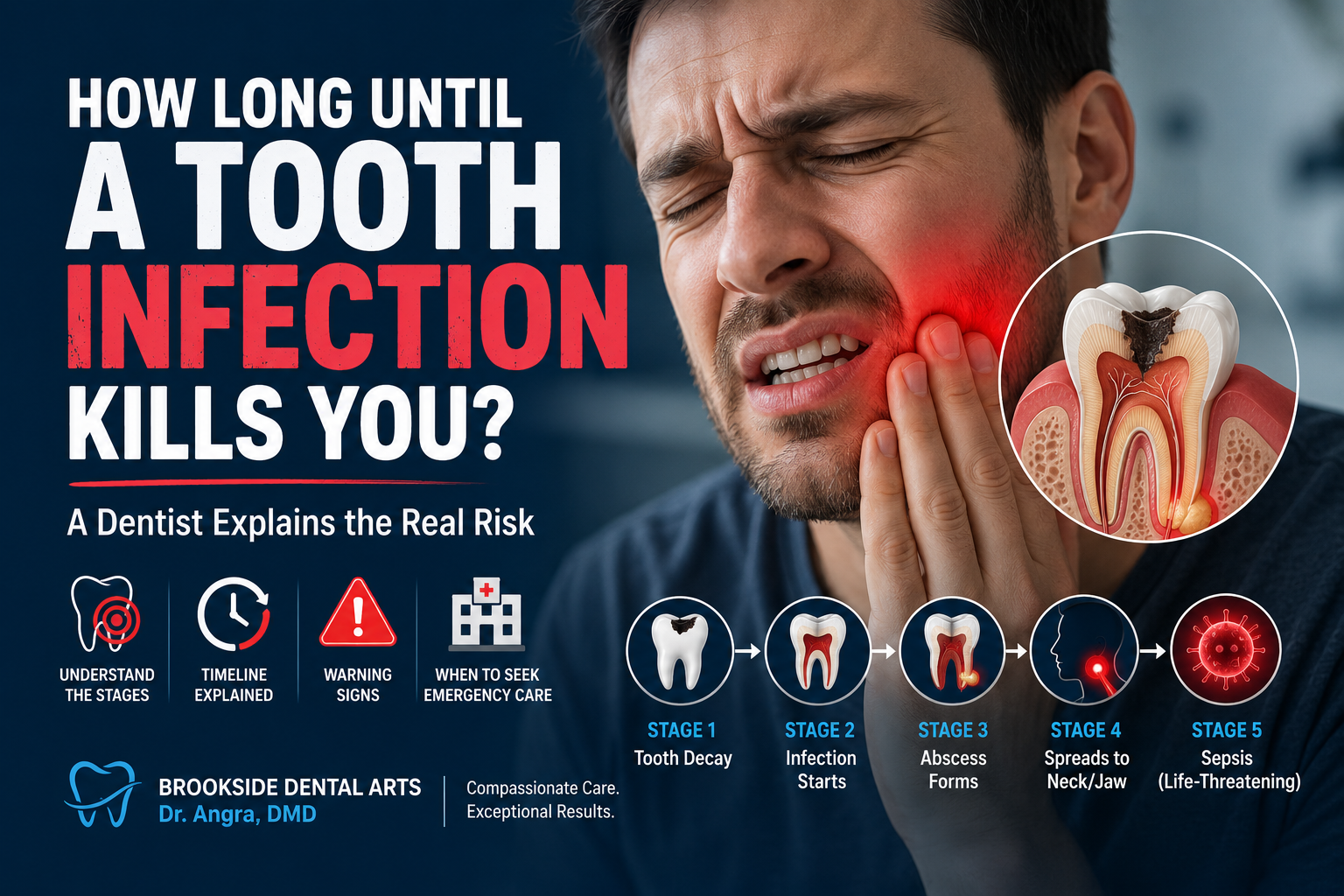
10 Jun How Long Until a Tooth Infection Kills You? Dr. Angra Explains the Real Risk
By Dr. Angra, DMD — Brookside Dental Arts
👩⚕️ Medically Reviewed by Dr. Angra, DMD
Dr. Angra is a practicing dentist and DMD graduate of Tufts University School of Dental Medicine, serving patients in Pennington, NJ and surrounding areas. This article is written from clinical experience and is intended for educational purposes. If you believe you have a dental infection, please contact a dental professional immediately.
🟢 Quick Answer
In rare but documented cases, an untreated tooth infection can become life-threatening within days to weeks if it spreads beyond the mouth to the jaw, neck, or bloodstream. A localized dental abscess does not kill you quickly — but one that progresses to Ludwig’s angina or sepsis can become fatal within 24 to 72 hours without emergency medical treatment. Any tooth infection left untreated is a serious health risk. See a dentist as soon as possible.
If you’re searching “how long until a tooth infection kills you,” chances are you or someone you care about is in pain right now — and worried about how serious it might be. That concern is not overblown. A tooth infection that spreads is one of the few dental conditions that can genuinely become life-threatening, and it has happened far more recently than most people realize.
As a dentist, I want to give you an honest, clear answer — not one designed to frighten you unnecessarily, but one that reflects the real clinical picture. The vast majority of tooth infections, when treated promptly, are straightforward to resolve. The danger arises when they are ignored, delayed, or inadequately treated and allowed to spread beyond the original site.
In this guide, I will walk you through exactly how a tooth infection progresses from a minor cavity to a life-threatening emergency, the timeline at each stage, the warning signs that demand immediate action, and what treatment options are available at different points in that progression
Can a Tooth Infection Really Kill You?
The short answer is yes — but context matters enormously.
A tooth infection confined to the tooth and immediate surrounding tissue is not going to kill you. It will cause significant pain, may damage the tooth beyond saving, and will worsen over time — but it is not immediately life-threatening at this stage. The danger begins when the infection is not treated and the bacteria begin to spread beyond the original site.
The human jaw and neck contain interconnected anatomical spaces — pathways of loose connective tissue that run continuously from the mouth down into the chest. Once bacteria from a dental abscess enter these spaces, the infection can travel rapidly, causing dangerous swelling that compresses the airway. In severe cases, the infection can also enter the bloodstream, triggering a systemic response called sepsis that can lead to multi-organ failure.
These are not theoretical risks. Cases of fatal dental infections are reported regularly in medical literature. In 2007, a twelve-year-old boy in Maryland died from a tooth abscess that spread to his brain. More recently, adults have died from untreated dental infections that progressed to Ludwig’s angina — a rapidly spreading infection of the floor of the mouth — within days of symptom onset.
💡 Key point
The blood clot is your body’s natural bandage after an extraction. The first 24 hours are the most critical window for protecting it. This is why all post-extraction instructions emphasize avoiding rinsing, spitting, and straws during this period.
The 5 Stages of a Tooth Infection — and How Fast Each Progresses
Understanding how a dental infection develops helps explain both the timeline and the risk at each stage. Here is the clinical progression from early decay to life-threatening emergency.
| Stage | What’s Happening | Typical Timeline | Danger Level |
|---|---|---|---|
| Stage 1Enamel/Dentin Decay | Bacteria penetrate enamel and dentin. No pain yet or mild sensitivity. | Weeks to months | 🟡 Low |
| Stage 2Pulp Infection | Bacteria reach the nerve. Throbbing pain, sensitivity to heat/cold begins. | Days to weeks | 🟠 Moderate |
| Stage 3Dental Abscess | Pus pockets form at the root or in gum tissue. Severe, constant pain. | Days to 1–2 weeks | 🔴 High |
| Stage 4Spread to Jaw / Neck | Infection spreads into bone (osteomyelitis) or neck soft tissue (Ludwig’s Angina). Airway at risk. | Hours to days | 🔴🔴 Critical |
| Stage 5Systemic Sepsis | Bacteria enter the bloodstream. Multi-organ failure possible. Life-threatening. | Hours | ⚫ Life-threatening |
The most critical takeaway from this timeline is that the transition from Stage 3 (abscess) to Stage 4 (spreading infection) can happen in a matter of days — and Stage 4 to Stage 5 can happen within hours. This is why dental infections demand prompt attention, not a wait-and-see approach.
How Long Until a Tooth Infection Becomes Dangerous?
This is the core question — and there is no single answer that applies to every person or every infection. The timeline depends on a range of factors including the type of bacteria involved, where the tooth is located, your immune system strength, and whether you have any underlying health conditions.
That said, here is what clinical experience and medical literature tell us about the general timeline:
Days 1 to 3: Acute Abscess Formation
Once bacteria reach the dental pulp and the body’s immune response can no longer contain them, a localized abscess typically forms within one to three days. At this stage, you will usually experience significant throbbing pain, swelling of the gum near the affected tooth, and sensitivity to pressure and temperature. The infection is still localized. Treatment at this stage — root canal therapy, drainage, or extraction combined with antibiotics if indicated — is highly effective and straightforward.
Days 3 to 7: Risk of Spreading Begins
If the abscess is not treated within the first few days, the body’s ability to contain it may begin to fail. The infection can begin tracking along anatomical pathways into the surrounding bone and soft tissue. Swelling may start to appear outside the gum — in the cheek, under the jaw, or on the floor of the mouth. Fever may develop. At this stage, treatment becomes more complex and may require both dental intervention and systemic antibiotics.
Days 7 to 14: Serious Complication Window
Infections that have been present for one to two weeks without adequate treatment enter a significantly more dangerous territory. Ludwig’s angina — a rapidly spreading cellulitis of the floor of the mouth and neck — can develop and progress quickly enough to compromise the airway within hours. At this point, hospital admission, intravenous antibiotics, surgical drainage, and in some cases airway management are required. This is no longer a dental emergency alone — it is a medical emergency.
Beyond 2 Weeks: Sepsis and Systemic Spread
An infection that has been left untreated for more than two weeks, or one that has spread to the neck, chest, or surrounding bone, carries a real risk of sepsis — a life-threatening systemic inflammatory response to infection. Sepsis from dental origin can develop rapidly once bacteria enter the bloodstream and may progress to septic shock and organ failure within 24 to 72 hours. This requires intensive care hospitalization and carries significant mortality risk even with treatment.
⚠️ Important
These timelines are general estimates. In patients with diabetes, compromised immune systems, or certain heart conditions, infections can spread significantly faster. There is no “safe” amount of time to leave a dental abscess untreated.
📞 Do you have tooth pain, swelling, or a bad taste that won’t go away? Please don’t wait. Contact Brookside Dental Arts for a same-day evaluation. Early treatment is the simplest, safest, and most affordable path forward. Book at brooksidedentalarts.com/contact
Warning Signs: When to Seek Emergency Care Immediately
The following symptoms indicate that a tooth infection may be spreading or has entered a dangerous stage. If you experience any of these, do not wait for a dental appointment — go to an emergency room or call emergency services immediately.
⚠️ 🚨 Go to the emergency room immediately if you have:
- Swelling that extends to the jaw, floor of the mouth, neck, or eye area
- Difficulty swallowing, speaking, or breathing
- Fever above 101°F (38.3°C) alongside tooth or jaw pain
- Inability to fully open your mouth (trismus)
- Rapid heartbeat, confusion, or extreme fatigue alongside tooth pain
- A feeling that your throat is closing or swelling from the inside
- Pain that spreads from the jaw to the ear, neck, or chest
These symptoms represent a medical emergency, not just a dental one. Emergency rooms are equipped to manage airway compromise and administer intravenous antibiotics in a way that a dental office cannot. Do not drive yourself if you are experiencing difficulty breathing or swallowing — call emergency services.
Tooth Infection Symptoms: Can It Wait vs. Go Now
Use this table as a quick reference to assess the urgency of your situation. When in doubt, always err on the side of seeking care sooner.
| Symptom | Can Wait (See Dentist Soon) | Seek Emergency Care NOW |
|---|---|---|
| Pain level | Mild to moderate, manageable | Severe, unrelenting, spreading |
| Swelling | Localised gum swelling only | Jaw, neck, floor of mouth, eye area |
| Fever | Not present | Present — any temperature above 101°F |
| Swallowing | Normal | Difficulty swallowing or opening mouth |
| Breathing | Normal | Any difficulty breathing |
| Taste/smell | Slight bad taste | Foul, persistent taste and bad breath |
| Fatigue | Mild tiredness | Extreme fatigue, confusion, rapid heartbeat |
If your symptoms fall consistently in the right-hand column, treat this as a medical emergency. Do not wait until morning, do not take pain medication and hope it passes.
Who Is at Higher Risk of a Rapidly Spreading Infection?
While a dental abscess can become dangerous for anyone, certain populations face a significantly accelerated risk of serious complications and should seek care even more urgently.
- People with diabetes — elevated blood sugar impairs the immune response and accelerates bacterial spread
- Individuals with HIV/AIDS or those on immunosuppressive medications following organ transplants
- Cancer patients undergoing chemotherapy or radiation, particularly to the head and neck
- People with heart valve conditions — dental bacteria can colonize damaged heart valves, causing endocarditis
- Elderly patients, whose immune systems may not mount as strong a response to early infection
- Pregnant women, for whom certain antibiotics are contraindicated and infections can affect the developing baby
- People who have been self-medicating with leftover antibiotics — partial antibiotic courses can create resistant bacterial strains that are harder to treat
If you fall into any of these categories and have signs of a dental infection, please seek care the same day and inform both your dentist and your physician.
Treatment Options: What to Expect at Each Stage
The good news is that tooth infections are very treatable — particularly when caught early. Here is what treatment looks like at different stages of progression.
Early Stage — Localized Abscess
The most common treatment for an early dental abscess is root canal therapy to remove the infected pulp, clean the canals, and seal the tooth. This can typically be completed in one to two visits and has a very high success rate. In some cases, the tooth may need to be extracted if it cannot be saved, followed by a bone graft and eventual implant or bridge restoration. Oral antibiotics are prescribed when there are signs of spreading infection, fever, or systemic involvement.
Spreading Infection — Cellulitis or Facial Swelling
When infection has begun to spread beyond the tooth into surrounding tissue, more aggressive treatment is required. This typically involves dental extraction or root canal combined with a course of intravenous or high-dose oral antibiotics. Surgical incision and drainage of the infected tissue may be necessary. The patient will usually need to be monitored closely over the following 24 to 48 hours to ensure the infection is responding to treatment.
Advanced Stage — Ludwig’s Angina or Sepsis
If the infection has reached the neck, floor of the mouth, or bloodstream, treatment requires hospital admission and a multidisciplinary team. This typically includes intravenous broad-spectrum antibiotics, surgical drainage of infected spaces, airway management (and in some cases intubation or tracheotomy), and intensive monitoring. Prompt dental intervention in the earlier stages is the most reliable way to prevent reaching this point.
How to Prevent a Tooth Infection From Becoming Dangerous
The single most effective thing you can do to prevent a dental infection from becoming life-threatening is to treat it early. Beyond that, the following practices significantly reduce both the risk of developing an infection and the risk of complications if one does occur.
- Attend regular checkups and professional cleanings at Brookside Dental Arts every six months — early decay detected at a checkup is a simple filling, not a root canal or extraction
- Do not ignore tooth pain, sensitivity, or swelling, even if it seems to come and go — intermittent pain is not a sign the infection is resolving, it may indicate the nerve is dying
- If prescribed antibiotics for a dental infection, complete the full course even if you feel better — stopping early allows resistant bacteria to survive and multiply
- Maintain excellent oral hygiene — brush twice daily with fluoride toothpaste and floss daily to prevent the decay that leads to infection
- Address cracked or broken teeth promptly — cracks are entry points for bacteria and can lead to pulp infection without obvious decay
- If you have diabetes or a compromised immune system, be especially vigilant about dental checkups and report any oral pain or swelling to both your dentist and your physician immediately
Related Resources From Brookside Dental Arts
If this article raised concerns about your oral health or a current dental issue, these related guides may also be helpful:
- What Is the Strongest Natural Antibiotic for a Tooth Infection? A Dentist Explains
- Why Does My Tooth Filling Hurt After Months? Causes, Signs & When to Call Your Dentist
- Emergency Dental Care at Brookside Dental Arts — Same-Day Appointments Available
- Root Canal Treatment — What to Expect, Costs, and Recovery
- Dental Fillings — Preventing the Decay That Leads to Infection
Final Thoughts
So, how long until a tooth infection kills you? In the worst-case scenario — a rapidly spreading infection in a vulnerable patient without access to timely care — it can happen within days. In more typical cases, the window between a manageable abscess and a life-threatening emergency is measured in weeks, not months. But that window closes faster than most people expect, and there is no reliable way to know from home which direction your infection is heading.
The message from this article is not panic — it is urgency. Tooth infections are very treatable, especially early. The risk of serious harm comes almost entirely from delay. If you are in pain, have swelling, or suspect a dental abscess, please do not wait.
At Brookside Dental Arts, Dr. Angra and our team are here to evaluate and treat dental infections promptly and compassionately. If you are in Pennington, NJ or the surrounding area, please contact us today. Your health and your life are always worth the phone call
📍 Book your evaluation: Contact Brookside Dental Arts at brooksidedentalarts.com/contact for a prompt assessment. We make every effort to see patients with dental infections the same day. Do not wait — early care saves teeth and lives.
About Dr. Angra

Dr. Angra earned her DMD from Tufts University School of Dental Medicine and has practiced dentistry across Massachusetts, New York, New Jersey, and India. A proud member of the ADA and NJDA, she is known for her compassionate approach and commitment to high-quality, patient-centered care. Outside the office, she enjoys hiking with her family and exploring New Jersey’s diverse food scene.
Sorry, the comment form is closed at this time.