

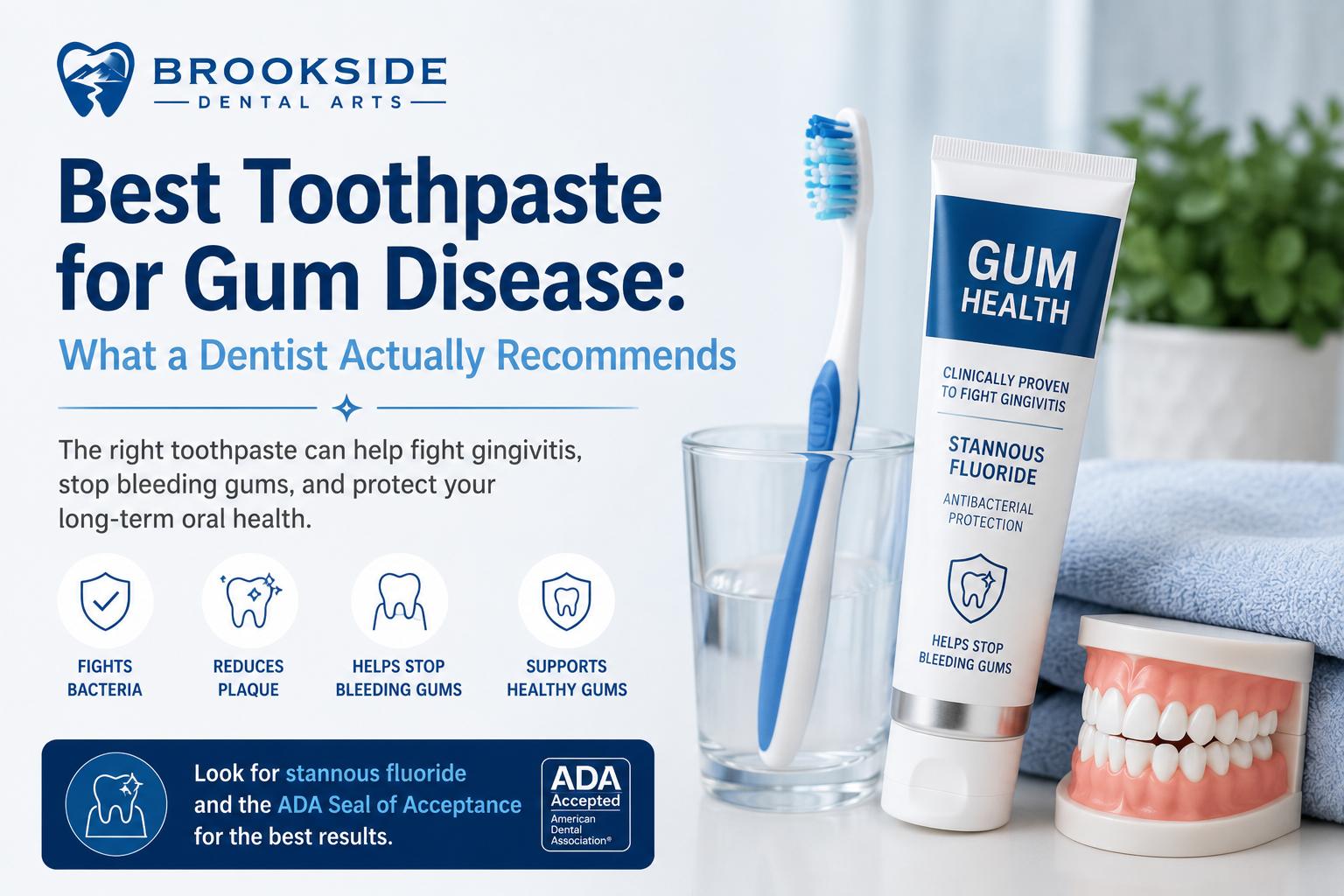
24 Jul Best Toothpaste for Gum Disease: What a Dentist Actually Recommends
👩⚕️ Written & Reviewed by Dr. Angra, DMD
Dr. Angra is a DMD graduate of Tufts University School of Dental Medicine and a practicing dentist in Pennington, NJ. This article reflects her clinical experience treating patients with gingivitis, gum disease, and periodontal disease. It is for educational purposes and does not replace a professional dental evaluation.
🟢 Quick Answer
The best toothpaste for gum disease contains stannous fluoride — a clinically proven antibacterial ingredient that reduces plaque, fights gingivitis-causing bacteria, and helps stop bleeding gums over time. Always look for the ADA Seal of Acceptance. That said, no toothpaste alone can reverse advanced gum disease. Professional dental treatment is always essential alongside a strong home care routine.
If you are searching for the best toothpaste for gum disease, you are already ahead of most people. Gum disease affects nearly half of all adults over 30—and the majority do not realize it until it is already causing damage.
The good news? In its earliest stage—gingivitis is fully reversible. The right toothpaste, used correctly, can make a real difference. The not-so-good news? Most toothpastes on the shelf are not doing what you think they are.
In this guide, Dr. Angra cuts through the confusion. She shares exactly which ingredients matter, which brands she actually recommends to her patients, and—critically—when toothpaste alone is not enough.
What Is Gum Disease? Gingivitis vs. Periodontal Disease
Gum disease is a bacterial infection of the gum tissue that surrounds and supports your teeth. It starts quietly and gets worse over time if ignored.
Gingivitis is the first stage. Plaque builds up along the gum line, triggers inflammation, and your gums become red, puffy, and prone to bleeding. At this point, no permanent damage has been done — the bone holding your teeth in place is still intact. Treat it now and the gums can fully recover.
Periodontal disease is what happens when gingivitis is left untreated. The infection goes deeper, the bone starts to deteriorate, and pockets form between your teeth and gums where more bacteria hide. This is harder to treat and leads to loose teeth, recession, and eventually tooth loss.
| Stage | Name | Key Symptoms | Can Toothpaste Help? |
|---|---|---|---|
| Stage 1 | Gingivitis | Red, swollen, bleeding gums — no bone loss yet | Yes — antibacterial toothpaste is effective here |
| Stage 2 | Early Periodontitis | Gum pockets 4–5mm, mild bone loss | Partially — professional cleaning essential too |
| Stage 3 | Moderate Periodontitis | Deeper pockets, significant bone loss | Limited — professional treatment required |
| Stage 4 | Severe Periodontitis | Major bone loss, loose or missing teeth | No — toothpaste alone is not enough |
| Dr. Angra’s Tip: Bleeding gums are not normal — they are a warning. Your gums are telling you something is wrong. If yours bleed every time you brush, that is your signal to act now, not wait until your next checkup. |
What to Look for in Toothpaste for Gum Disease
Not every toothpaste that says “gum care” on the label actually delivers meaningful antibacterial protection. Here is what genuinely matters.
1. Stannous Fluoride — The Ingredient That Actually Works
Stannous fluoride (SnF2) is the gold standard for fighting gum disease in over-the-counter toothpaste. Most toothpastes use sodium fluoride, which is great for cavities but has limited antibacterial action.
Stannous fluoride does both. It strengthens enamel and disrupts the bacterial biofilm (plaque) that causes gum inflammation. Multiple clinical studies confirm it significantly reduces bleeding gums, plaque, and gingivitis. If you take nothing else from this guide, remember this: look for stannous fluoride on the label.
2. The ADA Seal of Acceptance
Any toothpaste can make big claims on its packaging. The ADA Seal means those claims have been independently verified. For a gum health toothpaste, this seal tells you the antibacterial benefits are real — not just marketing language.
3. No Harsh Abrasives or SLS
Inflamed gums are already irritated. Toothpastes with high abrasivity or sodium lauryl sulfate (SLS) — the foaming agent in many standard formulas — can make inflammation worse.
If your gums are sore or sensitive, look for SLS-free options. Your gums will thank you for it.
Key Ingredients in Antibacterial Toothpaste for Gum Disease
Here is a quick-reference guide to the ingredients you will find in gum health toothpastes and exactly what each one does.
| Key Ingredient | What It Does | Best For |
|---|---|---|
| Stannous Fluoride | Antibacterial + strengthens enamel + reduces bleeding gums | Gingivitis, bleeding gums, sensitivity |
| Sodium Fluoride | Strengthens enamel and prevents decay | General cavity prevention alongside gum care |
| Potassium Nitrate | Desensitizes nerve endings inside teeth | Gum disease with sensitivity |
| Chlorhexidine (Rx only) | Powerful antibacterial, disrupts plaque biofilm | Advanced gum disease — prescribed by dentist |
| Zinc Citrate | Inhibits tartar formation and reduces bacteria | Early-stage gingivitis and tartar buildup |
| Baking Soda (Sodium Bicarbonate) | Gentle abrasive, neutralises acids, mild antibacterial | Mild plaque removal and pH balance |
Best Toothpaste for Gum Disease — Dentist-Reviewed
These are the options Dr. Angra most frequently recommends to patients at Brookside Dental Arts. No sponsored endorsements here — just honest clinical perspective.
| Toothpaste | Key Ingredient | Best For | Dr. Angra’s Note |
|---|---|---|---|
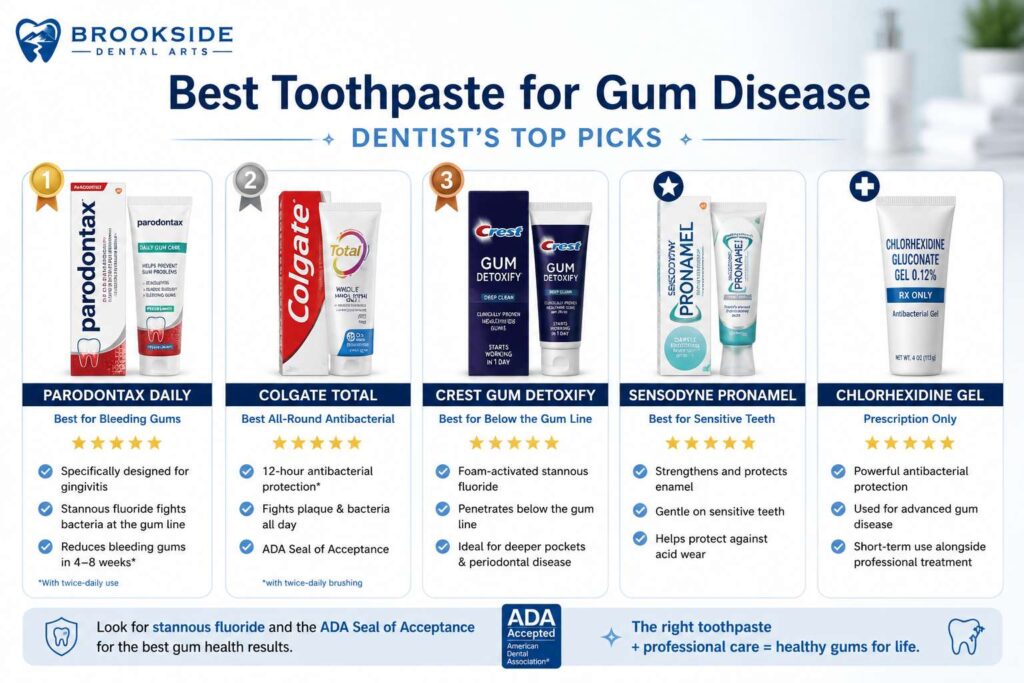
| Parodontax Daily | Stannous Fluoride | Bleeding gums, gingivitis | Top pick for bleeding gums |
| Colgate Total | Stannous Fluoride | All-round gum + cavity protection | Strong 12-hour antibacterial coverage |
| Sensodyne Pronamel | Sodium Fluoride + Potassium Nitrate | Gum disease with sensitivity | Great when sensitivity is also a concern |
| Crest Gum Detoxify | Stannous Fluoride | Below gum line plaque | Reaches where brushes miss |
| Colgate Gum Renewal | Stannous Fluoride | History of periodontal disease | Good for patients with recurring gum issues |
| Tom’s of Maine Antigingivitis | Sodium Fluoride, SLS-free | Gingivitis, natural preference | Ideal for sensitive mouths — no SLS |
| Prescription Chlorhexidine Gel | Chlorhexidine Gluconate | Moderate to severe periodontitis | Dentist-prescribed only — short-term use |
| ⚠️ A quick note: The right toothpaste depends on your specific situation. If you have been diagnosed with periodontal disease, always check with your dentist before switching formulas. |
Top Toothpaste Picks in Detail : Recommended by Dentist
✅Parodontax Daily — Best for Bleeding Gums
This is the one Dr. Angra reaches for first when a patient comes in with bleeding gums. Parodontax was developed specifically for gingivitis and has strong clinical evidence behind it.
Its stannous fluoride formula gets to work at the gum line where disease starts. Most patients notice a clear reduction in bleeding within four to eight weeks of consistent twice-daily use. The taste is slightly different from standard toothpaste — a little saltier — but patients adjust quickly once they see the results.
✅Colgate Total — Best All-Round Antibacterial
Colgate Total is one of the most extensively studied toothpastes available. It holds the ADA Seal and provides twelve hours of antibacterial protection against the plaque and bacteria behind gum disease.
It is a strong everyday option for patients in early to moderate stages of gum disease who want solid all-round protection without needing a specialist formula.
✅Crest Gum Detoxify — Best for Below the Gum Line
Standard toothpaste reaches the gum line. Crest Gum Detoxify is designed to go further. Its foam-activated stannous fluoride formula penetrates the pockets between the gum and tooth — exactly where gum disease-causing bacteria hide.
Dr. Angra recommends this one for patients who have been told they have deeper gum pockets or a history of periodontal disease.
✅Prescription Chlorhexidine Gel — For Advanced Gum Disease
When over-the-counter options are not enough, this is what Dr. Angra prescribes. Chlorhexidine gluconate is a powerful antibacterial agent that goes far beyond what any OTC toothpaste can deliver.
It is used short-term alongside professional periodontal treatment — not as a permanent daily toothpaste. Long-term use can cause tooth staining. Available by prescription only.
|
📞 Not sure which toothpaste is right for your situation? Book a gum health evaluation at Brookside Dental Arts. Dr. Angra will assess your gums and put together the right home care plan for you. Book at www.brooksidedentalarts.com/contact |
How to Get the Most Out of Your Gum Disease Toothpaste
Even the best toothpaste for gum disease underperforms if the technique is wrong. Here are six habits that make a measurable difference.
✔️Brush for a full two minutes, twice daily. Most people manage under 60 seconds — that is not enough time for the active ingredients to work.
✔️Use a soft-bristle toothbrush. Inflamed gums are already sensitive. Hard bristles do more damage than cleaning.
✔️Angle your brush at 45 degrees toward the gum line. That is where the bacteria live. Brushing straight across the tooth surface misses the most important area.
✔️Do not rinse immediately after brushing. Spit out the excess, but leave a thin film on your teeth and gums. This gives the active ingredients longer contact time to work.
✔️Floss at least once daily — non-negotiable. Toothpaste cannot reach between the teeth where a significant portion of gum disease begins.
✔️Consider an antibacterial mouthwash containing CPC (cetylpyridinium chloride) for extra protection between brushing sessions.
What Toothpaste Cannot Do for Gum Disease
This might be the most important section in this entire guide. So please read it carefully.
Toothpaste only works on surfaces it can physically reach. As gum disease progresses, bacteria move deeper into gum pockets between the tooth and gum that no toothbrush or toothpaste can access. And once tartar (calculus) has hardened below the gum line, brushing cannot remove it. Only a professional hygienist can.
Toothpaste is prevention and maintenance. It is not a cure. If you have anything beyond early gingivitis, you need professional treatment alongside better home care—not instead of it.
See your dentist — do not just switch toothpaste — if you have:
❌ Gums that still bleed after weeks of using antibacterial toothpaste
❌ Persistent bad breath that brushing and rinsing does not fix
❌ Gums that have pulled away from the teeth, making them look longer
❌ Teeth that feel loose or have visibly shifted
❌ Gum pockets deeper than 3mm measured at a dental visit
Frequently Asked Questions
Most dentists recommend toothpastes containing stannous fluoride for managing gum disease and gingivitis. Parodontax Daily, Colgate Total, and Crest Gum Detoxify are among the most clinically supported options. For advanced periodontal disease, a dentist may prescribe chlorhexidine gel.
Antibacterial toothpaste can reverse gingivitis — the earliest stage — when used consistently alongside daily flossing and professional cleanings. Once gum disease has progressed to periodontitis with bone loss and deep pockets, toothpaste alone cannot reverse the damage. Professional treatment is required.
Most patients who switch to a stannous fluoride toothpaste and improve their brushing and flossing see a meaningful reduction in bleeding gums within four to eight weeks. Consistency is everything — sporadic use will not deliver the same results.
Not ideal. Whitening toothpastes are generally more abrasive and may contain ingredients that further irritate already inflamed gums. Dr. Angra recommends switching to a dedicated gum health formula first, and returning to whitening once your gums are healthy.
Brookside Dental Arts at 245 S Main St, Suite D, Pennington, NJ 08534 provides comprehensive gum health evaluations. Contact Dr. Angra at (609) 737-7662 or book at brooksidedentalarts.com/contact.
Related Oral Health Guides From Brookside Dental Arts
What Is the Strongest Natural Antibiotic for a Tooth Infection? A Dentist Explains
How Long Until a Tooth Infection Kills You? A Dentist Explains the Real Risk
Emergency Dental Care at Brookside Dental Arts — Same-Day Appointments
Cosmetic Dental Bonding — Fix Chips, Gaps & Discoloration
Final Thoughts
The best toothpaste for gum disease is one that contains stannous fluoride, carries the ADA Seal, and is used correctly — every day, twice a day, for two full minutes. Parodontax, Colgate Total, and Crest Gum Detoxify are the strongest over-the-counter options for fighting gingivitis, reducing bleeding gums, and supporting healthy gums long term.
But remember: toothpaste is part of the answer, not the whole answer. If your gums are bleeding, your breath is not improving, or you have not had a professional cleaning in a while — the most important thing you can do is book an appointment. Early care is always simpler, faster, and less costly than waiting.
Book your gum health evaluation: Contact Brookside Dental Arts at www.brooksidedentalarts.com/contact or call (609) 737-7662. Dr. Angra will assess your gums and create the right plan to help you achieve healthy gums for life.
About Dr. Angra

Dr. Angra earned her DMD from Tufts University School of Dental Medicine and has practiced dentistry across Massachusetts, New York, New Jersey, and India. A proud member of the ADA and NJDA, she is known for her compassionate approach and commitment to high-quality, patient-centered care. Outside the office, she enjoys hiking with her family and exploring New Jersey’s diverse food scene.
Sorry, the comment form is closed at this time.