

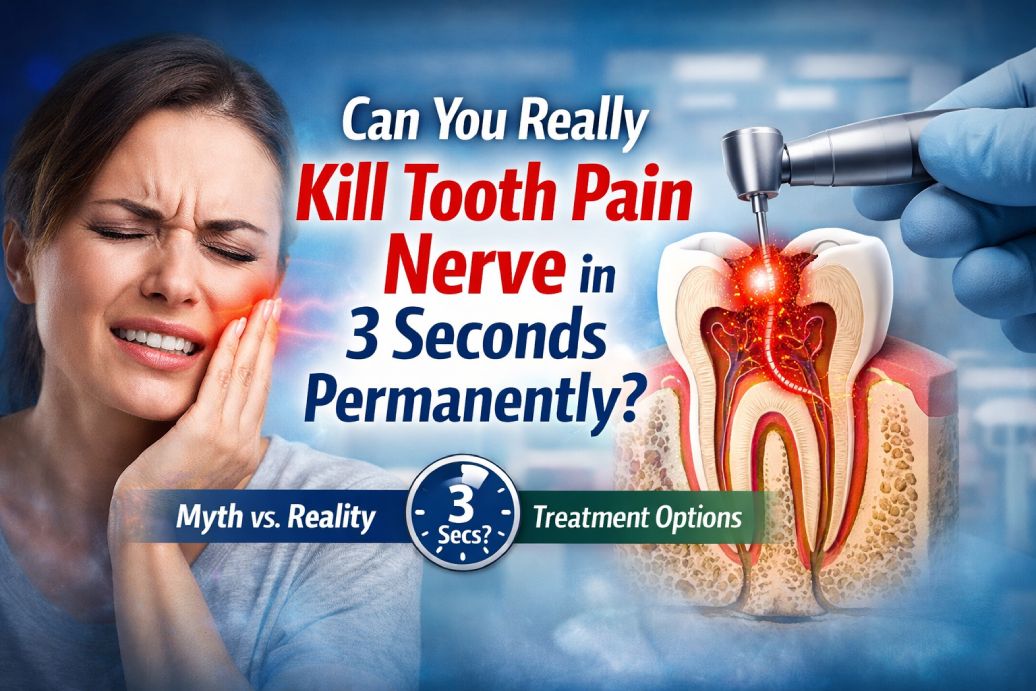
17 Apr Kill Tooth Pain Nerve in 3 Seconds Permanently — A Dentist Explains
👩⚕️ Medically Reviewed by Dr. Angra, DMD
Dr. Angra is a DMD graduate of Tufts University School of Dental Medicine and a practicing dentist serving patients in Pennington, NJ and surrounding areas. This article draws on clinical experience and current dental research. It is intended for educational purposes and does not replace a personalized dental consultation.
🟢 Quick Answer
No — it is not possible to kill tooth pain nerve in 3 seconds permanently at home. The tooth nerve sits deep inside the pulp, protected by layers of enamel and dentin that no topical remedy can safely penetrate in seconds. Home treatments like clove oil, ice, and saltwater can reduce pain temporarily — sometimes within minutes — but they do not remove or permanently treat the nerve. Permanent relief requires professional dental treatment: root canal therapy removes the infected pulp and seals the tooth, or extraction removes it entirely. If you are in significant pain, contact your dentist today.
If you have been searching for how to kill tooth pain nerve in 3 seconds permanently, you are almost certainly in real pain right now — and looking for the fastest possible answer. That is completely understandable. Tooth nerve pain can be one of the most intense sensations the human body produces, and when it strikes, all you want is for it to stop.
As a dentist, I want to give you an honest answer rather than a misleading one. The claim that you can permanently kill a tooth nerve in 3 seconds at home is medically impossible — and attempting some of the methods circulating online can cause serious harm. What I can tell you is what actually works for fast temporary relief, what the science says, and what professional treatment will permanently eliminate the pain.
Why You Cannot Kill a Tooth Nerve in 3 Seconds — The Real Science
To understand why this claim is impossible, you need to know where the tooth nerve actually lives. Inside every tooth is a soft core called the dental pulp — a chamber containing blood vessels, connective tissue, and nerve fibers. This pulp is encased by dentin, a hard bone-like layer, which is itself covered by enamel — the hardest substance in the human body
For any substance to permanently kill or remove the nerve, it would need to penetrate through enamel and dentin to reach the pulp chamber. No topical home remedy can do this safely or in any timeframe measured in seconds. What people experience when a remedy appears to “work in seconds” is temporary pain signal blockade — the remedy numbs surface tissue or reduces inflammation just enough to dull the signal. The nerve is untouched, the underlying infection is unchanged, and the pain will return.
🟢 Dr. Angra explains:
Home remedies buy you time — they do not buy you a cure. I have seen patients who managed pain at home for weeks before coming in. By the time they arrived, what started as a manageable abscess had become a spreading infection requiring significantly more complex treatment. Use home remedies while you book your appointment, not instead of it.
What Causes Tooth Nerve Pain? A Dentist Explains
Tooth nerve pain originates inside the pulp when the nerve tissue becomes irritated, inflamed, or infected. Understanding the cause helps explain both severity and the right treatment.
- Deep cavities that erode through enamel and dentin until bacteria reach the pulp
- Cracked or fractured teeth that allow bacteria and temperature to penetrate to the nerve
- Dental abscess — a pus-filled pocket at the root tip from pulp infection
- Exposed tooth root from gum recession, leaving nerve endings unprotected
- Trauma or injury that damages the pulp directly, even without visible external damage
- Old or failed fillings that allow bacteria to re-enter and infect the tooth
Constant throbbing pain that worsens at night usually points to advanced pulpitis or abscess. Spontaneous pain with no trigger often means the nerve is dying or already infected. Sharp pain triggered by temperature typically indicates early pulp irritation that may still be reversible with conservative treatment.
4 Dangerous Myths About Killing Tooth Nerve Pain Instantly
The internet is full of misleading claims about instant nerve fixes. Here are the four most dangerous myths — and the clinical facts behind each.
❌ MYTH: Applying bleach or hydrogen peroxide directly kills the tooth nerve instantly.
✅ FACT: Bleach is extremely caustic and will burn gum tissue and soft tissue severely. It does not reach the nerve. Even diluted hydrogen peroxide applied directly to an open cavity can cause chemical burns and worsen inflammation.
❌ MYTH: Clove oil permanently kills the nerve if applied long enough.
✅ FACT: Clove oil contains eugenol, which has genuine numbing properties — but it only acts on surface tissue. It cannot penetrate enamel and dentin to reach the pulp. It provides temporary relief, not permanent nerve removal.
❌ MYTH: If the pain stops after a home remedy, the nerve is gone and no treatment is needed.
✅ FACT: Pain reduction means the remedy temporarily blocked pain signals. The nerve, infection, and underlying damage are still there. Pain may also fade because the nerve is dying — but the infection continues spreading silently until it becomes a serious emergency.
❌ MYTH: Using a needle or sharp object to reach the nerve relieves pain permanently.
✅ FACT: This is one of the most dangerous DIY claims online. Attempting to pierce the inside of a tooth introduces bacteria directly into the pulp, causes severe pain and tissue destruction, and can lead to uncontrollable infection. Never attempt this under any circumstances.
7 Safe Home Remedies That Actually Reduce Tooth Nerve Pain
While no home remedy permanently kills tooth nerve pain, the following seven options have genuine evidence for temporary relief. Use these safely while you arrange a dental appointment — not as a substitute for professional care.
| Remedy | How It Works | How to Use | Safety |
|---|---|---|---|
| Clove Oil | Eugenol temporarily numbs exposed nerve endings. | Mix 2 drops with a carrier oil, apply using a cotton ball, and hold on the affected tooth for 10–15 minutes. | ✅ Safe when properly diluted. |
| Saltwater Rinse | Helps reduce bacteria and soothes inflamed gum tissue. | Mix ½ teaspoon of salt in 8 ounces of warm water. Swish for 30 seconds, 3–4 times daily. | ✅ Safe for regular use. |
| Cold Compress | Reduces blood flow to the area and temporarily numbs pain. | Apply an ice pack to the outside of the cheek for 15 minutes, then remove for 15 minutes. | ✅ Safe. |
| Ibuprofen (OTC) | Reduces inflammation and lowers pressure inside the tooth. | Take according to the package directions and with food if recommended. | ✅ Safe when used as directed. |
| Garlic Paste | Contains allicin, which has mild antibacterial properties. | Crush fresh garlic into a paste and apply gently to the affected area. | ⚠️ May irritate sensitive gums or tissues. |
| Peppermint Tea Bag | Menthol provides a mild cooling and numbing sensation. | Place a slightly warm or cooled peppermint tea bag against the sore tooth for about 20 minutes. | ✅ Safe. |
| Hydrogen Peroxide Rinse | Helps reduce bacteria around the affected tooth. | Mix equal parts 3% hydrogen peroxide and water. Swish for 30 seconds, then spit out. Do not swallow. | ⚠️ Avoid frequent or prolonged use. |
❌ MYTH: Using a needle or sharp object to reach the nerve relieves pain permanently.
✅ FACT: This is one of the most dangerous DIY claims online. Attempting to pierce the inside of a tooth introduces bacteria directly into the pulp, causes severe pain and tissue destruction, and can lead to uncontrollable infection. Never attempt this under any circumstances.
Temporary Relief vs. Permanent Treatment — Key Differences
This is the most important distinction to understand. Home remedies and professional dental treatment are not interchangeable options — they serve completely different purposes.
| Factor | Temporary Relief (Home) | Permanent Fix (Dentist) |
|---|---|---|
| What it does | Numbs pain or reduces inflammation briefly | Removes or treats the nerve permanently |
| How long it lasts | Minutes to a few hours | Permanently — no recurrence |
| Examples | Clove oil, ice, ibuprofen, saltwater rinse | Root canal treatment, tooth extraction, dental filling |
| Treats the cause? | No — only masks symptoms temporarily | Yes — addresses the infection or tooth damage |
| Safe long-term? | Suitable only as short-term relief | Yes — clinically proven and safe when performed by a dentist |
| Risk if overused | May mask a worsening infection or delay treatment | No ongoing risk when completed by a dental professional |
| Best used when | While waiting for a dental appointment | As soon as professional dental care is available |
The bottom line: use home remedies to manage discomfort while you wait for your appointment. Do not use them as a reason to delay that appointment. The longer an infected tooth nerve goes untreated, the more complex and costly the treatment becomes.
In tooth pain right now? Contact Brookside Dental Arts for a same-day or next-day evaluation. Dr. Angra will identify the exact cause and recommend the most conservative permanent solution. Book at brooksidedentalarts.com/contact or call (609) 737-7662
What to Do Right Now — Step-by-Step
If you are in tooth nerve pain while reading this, here is the most effective immediate action plan:
- Take ibuprofen (if safe for you) — it reduces both pain and pulp inflammation. Take with food and follow package dosing.
- Apply a cold pack to the outside of your cheek — 15 minutes on, 15 minutes off. Do not apply ice directly to the tooth.
- Dilute 2–3 drops of clove oil in a teaspoon of coconut oil. Apply to a cotton ball and hold gently against the tooth for 10–15 minutes.
- Rinse gently with warm saltwater — half a teaspoon of salt in 8oz of water, swish 30 seconds. This reduces bacteria and calms inflamed tissue.
- Sleep or rest with your head elevated. Lying flat increases blood pressure around the tooth and intensifies throbbing pain.
- Avoid hot foods, cold drinks, and chewing on the affected side until you see a dentist.
- Call Brookside Dental Arts to book your appointment. Early treatment is always simpler and less costly than delayed treatment.
When Tooth Nerve Pain Is a Dental Emergency
Most tooth nerve pain is urgent but not immediately life-threatening. However, certain symptoms indicate the infection has spread and requires emergency care right away.
Seek emergency care immediately if you have:
- Swelling that extends to the jaw, cheek, floor of the mouth, or neck.
- Fever above 101°F (38.3°C) accompanied by tooth pain.
- Difficulty swallowing, breathing, or opening your mouth fully.
- Rapid heartbeat, confusion, or extreme fatigue along with dental pain.
- Pain that spreads from the jaw to the ear, neck, or chest.
- A growing or draining pimple-like swelling (gum boil) on the gums.
In rare but serious cases, an untreated spreading infection can become life-threatening within a matter of days. If you want to understand exactly how this progression happens and why timing matters so much, we’ve covered it in detail in our guide on how long until a tooth infection kills you, which breaks down each danger stage step by step
Professional Treatments That Permanently Eliminate Tooth Nerve Pain
The only safe and permanent way to kill tooth nerve pain is through professional dental treatment that addresses the actual cause. Here are the main options Dr. Angra provides at Brookside Dental Arts.
Root Canal Therapy — The Gold Standard
Root canal therapy is the most common and effective treatment for infected or severely inflamed tooth nerve pain. Under local anaesthesia, Dr. Angra removes the infected pulp, thoroughly cleans and disinfects the root canals, and seals the tooth to prevent reinfection. The tooth is then typically restored with a crown. Root canal therapy permanently eliminates nerve pain while preserving your natural tooth. Modern root canals are no more uncomfortable than getting a filling.
Dental Filling or Crown
If the cavity has not yet reached the pulp, a filling may be all that is needed to stop the pain and protect the nerve from further irritation. If the tooth structure is significantly compromised, a crown may be placed to restore strength. These options are appropriate for earlier-stage nerve irritation before a full infection develops.
Tooth Extraction
When a tooth is too severely damaged or infected to be saved through a root canal, extraction becomes the only remaining option to permanently eliminate the pain. This involves carefully removing the entire tooth, root and all, which immediately resolves the nerve pain at its source. While losing a tooth is never the first choice, it is sometimes the safest path forward — particularly when infection has progressed too far for the tooth to be restored. Following extraction, Dr. Angra will discuss replacement options such as a dental implant or bridge to restore both function and appearance. If your pain is severe and you are unable to wait for a routine appointment, our emergency dental services are available for prompt same-day evaluation.
Frequently Asked Questions
These questions are written in plain visible text — not accordion/toggle format — so Google can read and index them for the People Also Ask section and Featured Snippets.
No. There is no safe method to permanently eliminate a tooth nerve in 3 seconds at home. The nerve is protected deep inside the tooth by enamel and dentin. Home remedies can temporarily reduce pain signals but cannot remove or permanently treat the nerve. Only root canal therapy or extraction by a dental professional can permanently eliminate tooth nerve pain.
Clove oil applied to the affected area typically provides the fastest temporary relief because eugenol, its active compound, acts as a natural anaesthetic on contact. Ibuprofen taken orally is also highly effective because it reduces both pain and the pulp inflammation driving the pain. A cold compress on the cheek can provide near-instant surface numbing.
This is a common pattern and is not a sign the problem is resolving. Pain may temporarily decrease as the nerve becomes less reactive or because a home remedy dulled the signal. If the underlying infection has not been treated, the pain will return — often worse. In some cases, pain fades because the nerve is dying, but the infection continues spreading silently.
You should not wait more than 24 to 48 hours if the pain is severe, constant, or accompanied by swelling or fever. Even for milder pain, waiting more than a week significantly increases the risk of infection spread, the tooth becoming unsalvageable, and treatment becoming more complex and costly.
Not always. Early nerve irritation caused by a cavity that has not yet reached the pulp can often be treated with a filling. However, if the pain is constant, throbbing, or spontaneous, it usually indicates the nerve is already inflamed or infected and root canal therapy is likely needed.
A dying nerve often causes intense pain as it becomes inflamed, followed by reduction as it loses function. However, a dead nerve in an infected tooth allows bacteria to continue spreading into bone and tissue. Pain going away without treatment is a reason to see a dentist — not a reason to feel relieved.
Brookside Dental Arts at 245 S Main St, Suite D, Pennington, NJ 08534 offers same-day and urgent appointments for patients with tooth pain. Contact us at (609) 737-7662 or book online at brooksidedentalarts.com/contact.
Related Guides from Brookside Dental Arts
- What Is the Strongest Natural Antibiotic for a Tooth Infection? A Dentist Explains
- How Long Until a Tooth Infection Kills You? A Dentist Explains the Real Risk
- Emergency Dental Care at Brookside Dental Arts — Same-Day Appointments
- Dental Fillings & Crowns — Pennington, NJ
Final Thoughts
The desire to kill tooth pain nerve in 3 seconds permanently is completely understandable — nerve pain is genuinely debilitating. But the truth is that no home remedy can permanently eliminate a tooth nerve safely or in seconds. What home remedies can do is provide real, meaningful temporary relief while you arrange the professional care that will actually solve the problem.
At Brookside Dental Arts, Dr. Angraprovides prompt, compassionate, and thorough care for patients with tooth pain. Whether you need a filling, root canal, or extraction, the goal is always to eliminate your pain permanently with the most conservative treatment possible. If you are in Pennington, NJ or the surrounding area and are in tooth pain right now, please do not delay.
Book your appointment: Contact Brookside Dental Arts at brooksidedentalarts.com/contact or call (609) 737-7662 for a same-day evaluation. We are here to get you out of pain permanently.
About Dr. Angra

Dr. Angra earned her DMD from Tufts University School of Dental Medicine and has practiced dentistry across Massachusetts, New York, New Jersey, and India. A proud member of the ADA and NJDA, she is known for her compassionate approach and commitment to high-quality, patient-centered care. Outside the office, she enjoys hiking with her family and exploring New Jersey’s diverse food scene.
Latest Posts



Sorry, the comment form is closed at this time.