

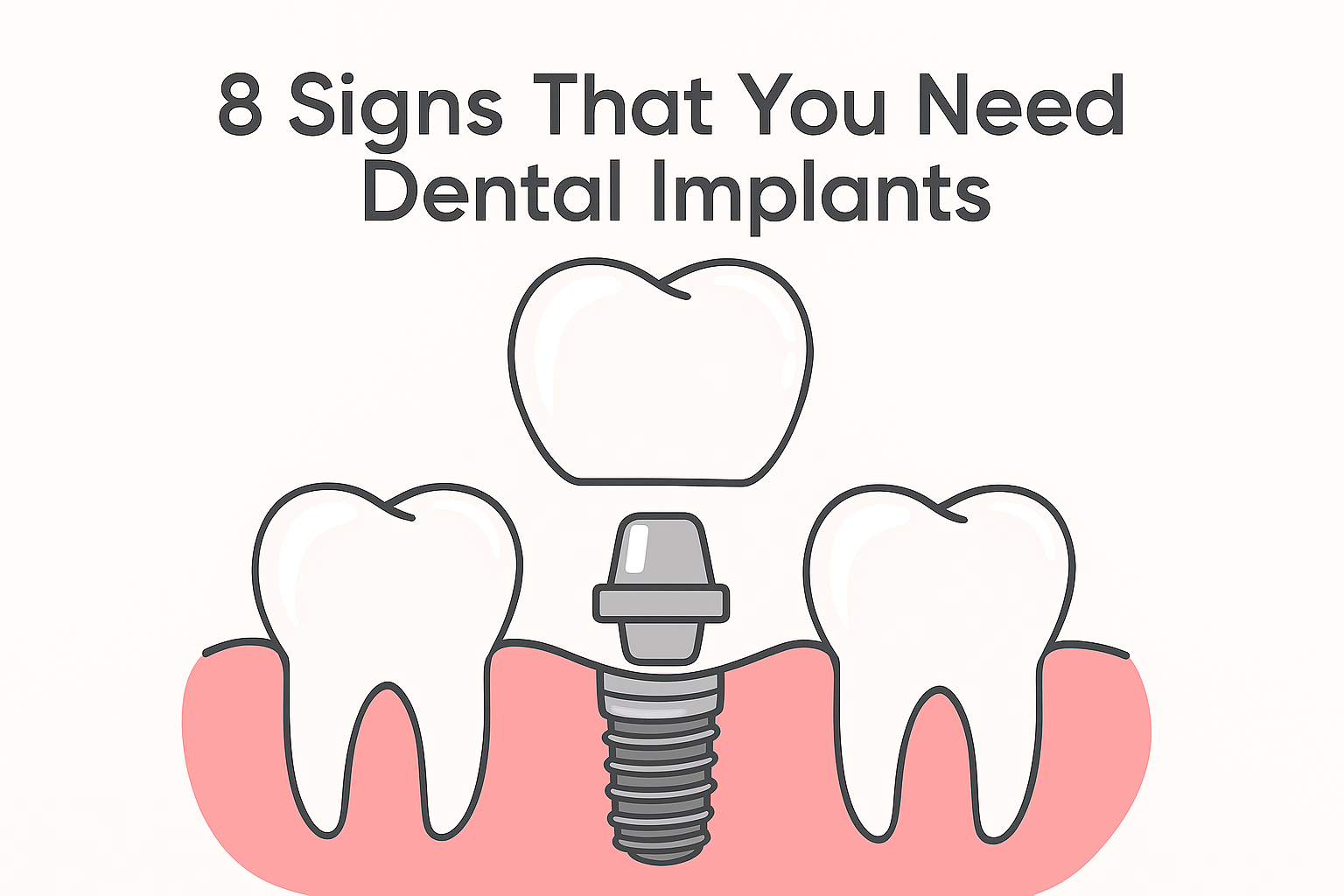
09 Jun 8 Signs That You Need Dental Implants
Expert Insight by Dr. Angra, Brookside Dental Arts, Pennington, NJ
Dental health plays a vital role in overall well-being, but missing or damaged teeth can lead to discomfort, embarrassment, and even bone loss. If you’ve been struggling with tooth issues and wondering about solutions, this article will help you determine whether dental implants are right for you.
Here are the 8 signs that you need dental implants, as recognized by top dental professionals like Dr. Angra at Brookside Dental Arts in Pennington, NJ.
1. You Have One or More Missing Teeth
The most obvious sign is a missing tooth. Whether due to injury, decay, or age, a lost tooth can affect your bite, speech, and smile. Dental implants are the most natural-looking, durable replacement option available today. They not only restore aesthetics but also prevent nearby teeth from shifting and causing further oral health issues. Replacing a missing tooth promptly helps maintain the integrity of your entire dental structure.
2. You Have Loose Dentures or Partials
If you constantly worry about your dentures slipping while eating or speaking, implants can offer permanent stability. Implant-supported dentures anchor securely to your jawbone, eliminating the discomfort of loose appliances. This provides greater confidence in social situations and improves your ability to eat a variety of foods. Many patients describe implant-supported dentures as life-changing in terms of comfort and functionality.
3. You Avoid Certain Foods Due to Pain or Difficulty Chewing
Chewing challenges often indicate tooth instability or gaps in your bite. Dental implants restore full bite force, allowing you to enjoy your favorite foods without fear. They help distribute pressure evenly across your jaw, reducing strain and protecting your remaining natural teeth. Over time, this improved function can lead to better nutrition and overall health.
4. You Have Severe Tooth Decay or Infection
When a tooth is beyond saving through root canal or fillings, extraction may be necessary. In these cases, replacing it with an implant helps preserve your oral health and prevents jawbone deterioration. Acting quickly to replace a decayed or infected tooth minimizes the risk of spreading infection and supports long-term oral stability. Dental implants serve as a reliable foundation where natural tooth roots have failed.
5. Your Facial Appearance Has Changed Due to Bone Loss
Missing teeth cause jawbone loss over time, which leads to a sunken facial appearance. Dental implants stimulate bone regeneration, preserving your natural facial structure. This not only restores your smile but also supports the cheeks and lips, contributing to a more youthful appearance. In the long run, implants help prevent premature aging associated with tooth loss.
6. You’re Tired of Replacing Crowns or Bridges
Traditional dental bridges and crowns often need replacements over the years. Implants, on the other hand, are designed to last for decades with proper care, offering a cost-effective long-term solution. They eliminate the need to alter healthy neighboring teeth, unlike bridges, and are less prone to complications. Many patients find implants to be a more reliable and low-maintenance option in the long term.
7. You Experience Jaw Pain or Misalignment
Gaps from missing teeth can cause neighboring teeth to shift, leading to TMJ issues, uneven bite, or discomfort. Dental implants maintain the natural alignment of your teeth and jaw. By keeping your bite balanced and supported, implants help reduce strain on the jaw muscles and joints. This can alleviate pain and prevent the progression of bite-related disorders.
8. You Want a Long-Term, Low-Maintenance Solution
Unlike dentures that require adhesives or special cleaning, implants function like natural teeth. You brush and floss them just as you would your original teeth—no extra steps, just better quality of life. With proper care, dental implants can last a lifetime, making them an excellent investment in your smile and health. Their durability and simplicity make daily oral hygiene easy and stress-free.
4 Types of Dental Implants: Which One is Right for You?
- Endosteal Dental Implants
These are the most common type, surgically placed into the jawbone. They provide strong, lasting support. Endosteal implants are typically made of titanium and shaped like small screws, providing a sturdy foundation for one or more artificial teeth. They are ideal for patients with good bone density and are widely regarded for their high success rates and long-term durability.
- Subperiosteal Dental Implants
Ideal for patients with minimal bone density, these sit on top of the jawbone but under the gum line. Rather than being embedded in the bone, these implants use a custom metal framework that rests beneath the gums, making them suitable for those who cannot undergo bone grafting. Subperiosteal implants offer a less invasive alternative for patients seeking stable, functional tooth replacements.
- Zygomatic Dental Implants
A complex option used when jawbone structure is insufficient, anchoring into the cheekbone.This technique bypasses the need for bone grafts by using the zygomatic bone as a secure anchor point, making it suitable for patients with severe bone loss in the upper jaw. While more advanced than traditional implants, zygomatic implants provide a dependable solution for restoring full upper arches.
Also Read: Full Mouth Dental Implants
- All-on-4® Implants (Full Mouth Implants)
Designed for patients needing full-arch restoration, using four implants to secure an entire upper or lower denture. This method offers faster treatment time and fewer implants, reducing recovery and surgical complexity. All-on-4 implants provide a permanent, natural-looking solution for those who have lost most or all of their teeth, restoring function and confidence in one transformative procedure.
Why Choose a Dental Implants Periodontist?
Choosing a dental implants periodontist like Dr. Angra ensures that you receive expert care from a specialist in gum and bone health. Periodontists are uniquely qualified to assess your bone structure, perform precise implant placements, and address underlying issues like periodontal disease.
At Brookside Dental Arts, we prioritize comprehensive evaluations and long-term results. Every implant plan is tailored to your oral and overall health goals.
Full Mouth Dental Implants Cost: What to Expect
The cost of full mouth dental implants can vary significantly depending on the type of implants, the materials used, the number of implants required, and whether any preparatory procedures (like bone grafting) are necessary.
At Brookside Dental Arts, we understand that every patient’s needs are unique. We offer customized treatment plans and flexible payment options to make dental implants more accessible. During your consultation with Dr. Angra, we’ll discuss your options in detail and provide a clear outline of the costs involved based on your individual situation
Schedule Your Consultation with Dr. Angra Today
If you recognize any of these 8 signs in your own smile, it may be the perfect time to explore the benefits of dental implants. At Brookside Dental Arts in Pennington, NJ, our expert team is here to support you with personalized care every step of the way.
📞 Call us today to schedule your personalized consultation
📍 Conveniently located in Pennington, NJ
🦷 Trusted care by dental implant expert Dr. Angra
Rediscover the power of a full, functional smile—starting today.
FREQUENTLY ASKED QUESTIONS (FAQ)
1. How do I know if I need a dental implant?
Discover the 8 Signs That You Need Dental Implants—like jaw pain, shifting teeth, or loose dentures. Know when it’s time to restore your smile confidently.
2. What is the best age for dental implants?
Dental implants are suitable for adults of all ages once jawbone growth is complete—typically after the age of 18. Whether you’re in your 30s, 50s, or even 70s, if you’re in good overall health with adequate bone density, dental implants can be a long-lasting solution for restoring your smile.
3. What is the cost of full mouth dental implants?
The cost of full mouth dental implants varies based on several factors, including the type of implants (such as All-on-4®), the number of implants required, bone density, materials used, and whether procedures like bone grafting are needed.
4. Is a tooth implant painful?
Most patients report minimal discomfort during and after the dental implant procedure, often comparing it to a simple tooth extraction. At Brookside Dental Arts, we use advanced techniques and local anesthesia to ensure a comfortable experience, followed by detailed aftercare instructions for a smooth recovery.
5. Can I avoid dental implants?
In some cases, alternatives like bridges or dentures may be viable, but they don’t offer the same stability or bone preservation benefits as implants. Avoiding implants might lead to progressive bone loss, shifting teeth, and other complications—so it’s best to consult with Dr. Angra to explore the most suitable and lasting solution for your dental health.
6. When is it too late for implants?
It’s rarely ever “too late” for dental implants. Even patients with significant bone loss may still be eligible, thanks to options like bone grafting or specialized implants such as zygomatic or All-on-4® systems. A comprehensive evaluation at Brookside Dental Arts will help determine the best path forward, no matter your age or dental history.

Sorry, the comment form is closed at this time.